
EN
What are you looking for?
PP spray towers scrub corrosive acid gas with proven wet scrubbing technology. Polypropylene construction, low maintenance, built to custom specs since 2005.
Walk a vent line from a plating tank, a chemical storage area, or a semiconductor fume hood and you will usually end at a scrubber — and a large share of those scrubbers are PP spray towers. Simple machines on paper: wet gas meets a curtain of liquid, and contaminants dissolve or drop out of the airstream. But the difference between a unit that runs for fifteen years and one that corrodes in two comes down to material, design and fabrication quality.
This guide explains what a PP spray tower is, how wet scrubbing technology removes acid gases, where these systems fit alongside packed-bed and Venturi scrubbers, and the practical questions to ask before you buy. If you are responsible for air treatment in a chemical, plating or industrial process, this is the overview you want.
A PP spray tower uses sprayed liquid droplets to absorb acid gases and capture mist and particulates before they reach the atmosphere.
Polypropylene resists a wide range of corrosive chemicals, which is why it dominates scrubber construction.
Spray towers suit coarse mist, dust and soluble gases; packed beds add surface area for harder absorption jobs.
Regular nozzle, pump and media checks keep a scrubber efficient — most failures trace back to skipped maintenance.
Buying from a fabricator with process knowledge beats buying a box unit when your exhaust chemistry varies.
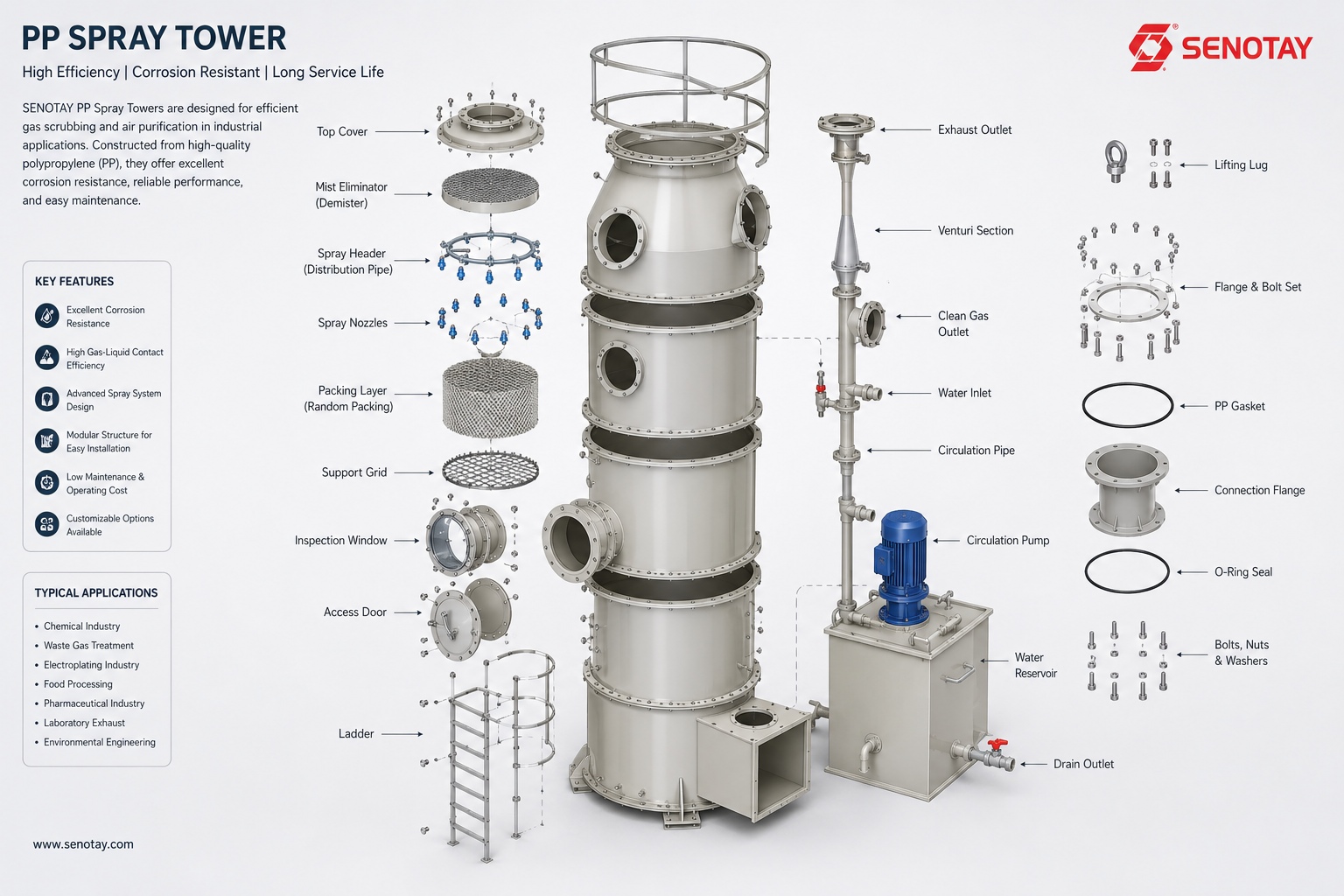
A spray tower is a vertical (or sometimes horizontal) vessel. Contaminated air is pushed or pulled up through the shell while nozzles release a fine liquid mist from above, and the two streams collide. Soluble gases dissolve into the droplets, while mist and particles get wetted out on the way through. That simplicity is why the PP spray tower shows up in more fume lines than any other scrubber design.
The design has almost no moving parts beyond the recirculation pump, which is a large part of its appeal.
The recirculation loop is the heart of the system. Liquid is pumped from a sump at the base up to the nozzles, contacts the gas, then falls back to the sump, where solids drop out and fresh reagent is metered in to hold the chemistry. When the loop is balanced, removal efficiency stays high without much operator attention.
Contaminated air enters near the bottom through a tangential or vertical inlet.
Spray nozzles release a fine mist that contacts the rising gas.
Soluble gases dissolve into the droplets; mist and particles are captured.
A demister at the top removes entrained droplets so clean air leaves dry.
Scrubber liquid recirculates through a pump, with fresh makeup added as needed.
PP is not the only scrubber material, but it is the default for good reason — and it has limits. Continuous service temperatures typically sit below about 80 °C, so a fabricator should always confirm material choice against your actual gas temperature and chemistry before building. PP spray tower construction usually starts from welded polypropylene sheet and plate, which keeps cost down while staying corrosion-resistant.
Excellent resistance to acids, alkalis and salts at moderate temperatures.
Lightweight compared with metal or FRP, lowering support and installation cost.
Welded construction means few fasteners and fewer leak paths.
UV-stabilized grades hold up well to outdoor installation.
All three scrub gas, but each is best at a different job — and a PP spray tower is often the first choice when your pollutant is a soluble gas or acid mist. Choosing the right one early saves both capital and operating cost.
Many real installations combine approaches — a spray section for bulk removal ahead of a packed section for polish. Senotay designs each system around the actual pollutant, not a catalogue picture.
PP wet scrubbers earn their keep wherever corrosive fumes are generated indoors or near occupied areas. Inside a PP spray tower, each pollutant needs a scrubbing liquid matched to its chemistry.
Beyond these, spray towers handle welding fumes, laboratory exhaust, battery production gases and general dust-laden air where particles can be wetted out. In a semiconductor fab, HF exhaust is one of the toughest streams a spray tower sees — and one of the most important to get right.
The PP spray tower you specify is only as good as the design data behind it. Give your supplier the full picture and the unit is sized right the first time.
Exhaust airflow in m³/h and the pressure drop your fan can afford.
Gas temperature and humidity — PP has a practical operating ceiling.
Liquid-to-gas ratio and recirculation tank volume for steady chemistry.
Nozzle selection and access panels for cleaning without disassembly.
Whether the unit must be explosion-rated, indoor or outdoor spec.
A serious fabricator responds with a datasheet and a clear drawing, not just a price. Ask for both before you commit, and check the datasheet against your actual fan curve — a mismatch here is a common cause of under-performing scrubbers.
Scrubbers rarely fail dramatically — they degrade. The causes are almost always the same three or four things.
Clogged nozzles are the number-one cause of falling removal efficiency.
Recirculation pumps need regular inspection and seal checks.
Sump sludge builds up as solids settle out; scheduled cleaning matters.
Inspect weld seams and flanges over time for stress cracking.
Watch the differential pressure gauge — a climb means the media or nozzles are loading up.
Keep a log of pH, flow and pressure, and drift is caught early. A well-built PP spray tower routinely serves more than a decade.
Air treatment equipment is a long-term asset, so the relationship matters as much as the hardware. The best fabricators ask questions before they quote: what is in the gas, how hot is it, how much airflow, and what are your local discharge limits.
Share a complete gas analysis, not just the pollutant name.
Clarify discharge limits and whether air can be returned to the room.
Ask about fabrication standards, weld quality and pressure testing.
Get a commissioning and training plan in writing with delivery.
A supplier that walks through these details with you is building a system around your PP spray tower, not moving a box.
A PP spray tower removes acid gases, ammonia, soluble organic vapors and wetted particulates. Removal efficiency depends on solubility and contact time, so confirm your full pollutant list with the supplier.
It is typically recirculated and refreshed continuously, with pH monitored. Replacement frequency depends on pollutant loading rather than a fixed schedule.
PP has temperature limits, and explosive gas needs careful design review. Give your supplier the full gas analysis and they will flag constraints before quoting.
Yes. Senotay has fabricated custom dust collectors and air treatment equipment since 2005, so a unit can match your space and ducting exactly.
Often yes. A fabricator can size a PP spray tower to your existing ducting and fan, then build it to match — give them the airflow, static pressure and layout.
Choosing the right PP spray tower comes down to honest data and a fabricator who understands your process. Senotay (senotay.com), a Chinese manufacturer since 2005 with ISO 9001, 14001 and 45001 certification, builds industrial dust collectors, air filtration, ventilation, purification and conveying equipment to suit the application — not the other way around. Send your exhaust details and get a system designed around your pollutant, your airflow and your site. That is how a scrubber becomes a ten-year asset instead of a maintenance problem.