
EN
What are you looking for?
Some dust is easy to see. The fine haze you cannot see, particles smaller than a micron that cling to filters, settle on electronics, and drift into exhaust stacks, is often the most damaging, and it is exactly what bag filters struggle to stop. That is where a horizontal electrostatic precipitator earns its place. It uses high-voltage precipitation to charge particles and pull them out of the gas stream with an efficiency ordinary filters cannot match. In this article, we will walk through how horizontal electrostatic precipitators work, why dry electrostatic precipitator design suits fine and sticky dust, and how to evaluate industrial ESP systems before you buy.
ESPs capture submicron particles that fabric filters miss, with high collection efficiency.
The horizontal layout favors large gas volumes and low pressure drop.
Dry design keeps collected dust in solid form, simplifying handling and disposal.
Efficiency, energy use, and maintenance decide total cost, not just the purchase price.
An electrostatic precipitator cleans gas by charging dust particles and collecting them on oppositely charged plates. No filter medium is involved, which is why ESPs are popular for hot, sticky, or corrosive gas streams that would wreck a fabric bag in a matter of weeks.
Inside the unit, discharge electrodes run at high voltage and fill the space with a corona discharge, an ion cloud that gives every passing dust particle an electric charge. The charged particles then drift toward grounded collection plates, where they stick until cleaning knocks them loose. Because the force is electric rather than mechanical, even the smallest particles respond.
Horizontal ESPs move the gas stream horizontally through a long treatment zone, which gives particles more residence time under the electric field. That extra time improves collection efficiency and makes the horizontal layout the natural choice for large industrial gas volumes where space along the flow path is available.
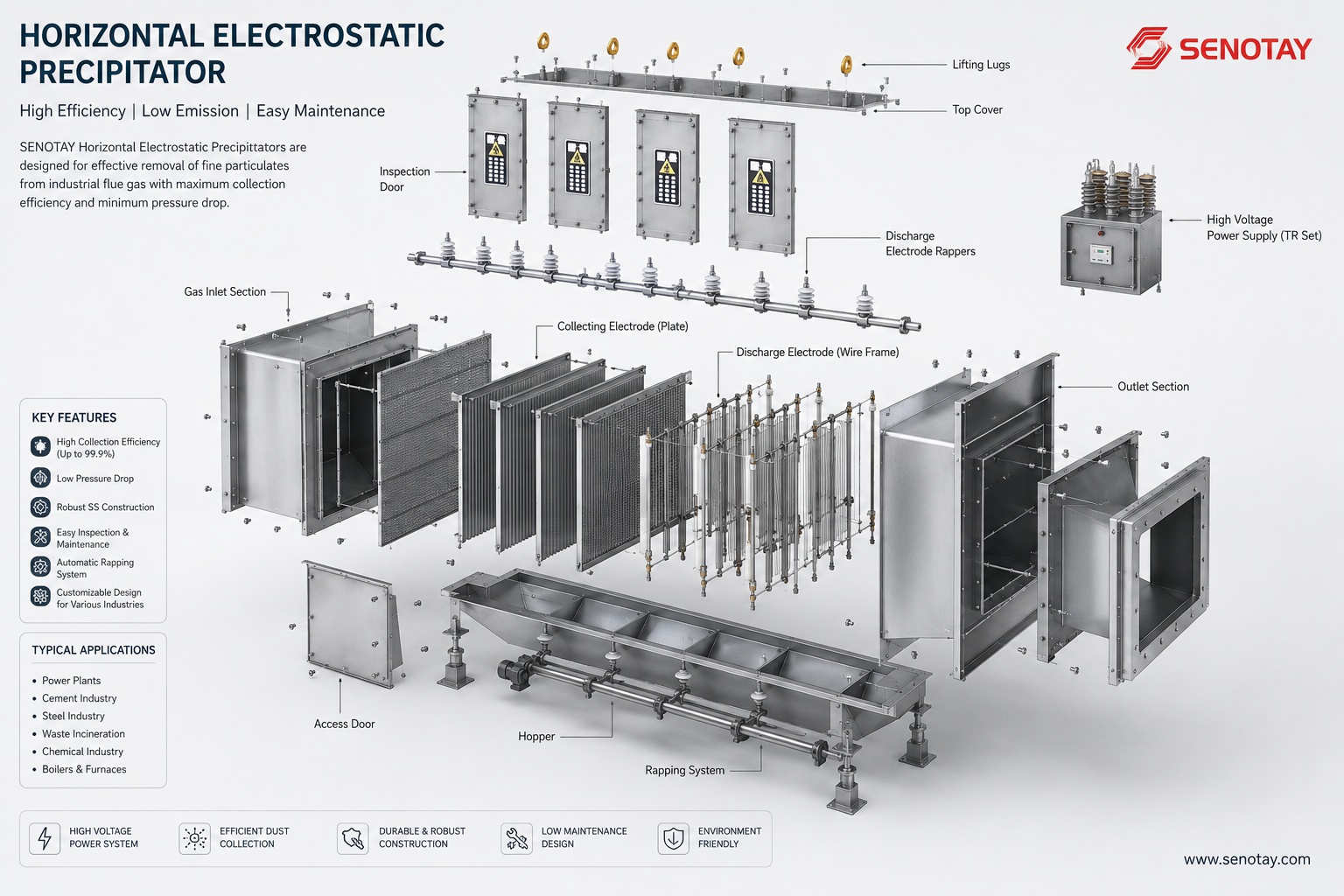
Every ESP is built around discharge electrodes, collection plates, and a rapping system that shakes collected dust off the plates into hoppers below. The spacing and configuration of these elements largely determine collection efficiency and pressure drop, and small geometry changes produce measurable differences in outlet emissions.
A high-voltage transformer-rectifier feeds the electrodes, and modern controls adjust voltage automatically as dust loading changes. Good control software keeps the unit running near its peak efficiency without the arcing or sparking that would interrupt collection.
Ash handling is the part nobody sees until it fails. Hoppers, level switches, and the discharge system need to be sized for the peak dust load, because a full hopper that goes unnoticed can short a field and drop collection efficiency overnight.
Fabric filters excel at medium-size particles but struggle with submicron fines and with dust that binds to the filter surface. ESPs dodge both problems: they rely on electric force rather than physical sieving, so they collect even the smallest particles, and dry collected dust simply drops into a hopper instead of clogging a medium.
One caveat is worth knowing. Collection efficiency depends partly on dust resistivity. Very low resistivity makes particles lose their charge too quickly; very high resistivity makes them hold it too stubbornly. Conditioning the gas, by adjusting temperature or humidity, brings resistivity into the sweet spot, and experienced suppliers design for this from the start.
Submicron particles are captured by electrostatic force, not by mesh size.
Hot gas streams cause no damage because there are no filter bags to burn or degrade.
Sticky or oily dust is collected on plates and rapped free, rather than binding to a filter.
Large volumes are handled with low pressure drop, keeping fan energy in check.
ESPs appear wherever exhaust must be cleaned at scale: power boilers, cement kilns, incinerators, glass furnaces, metal processing, and chemical plants. In each setting the same strengths matter, high efficiency, low pressure drop, and continuous operation.
There is also a growing retrofit market. Many plants already own an ESP that drifts below spec, and an upgrade to modern controls or additional fields restores performance at a fraction of the cost of a new unit. Asking a supplier about retrofit options is often the fastest route back to compliance.
Choosing the right size is where engineering judgment matters most, and it is where a horizontal electrostatic precipitator earns or loses its reputation. A unit that is too small struggles to meet emission limits; one that is too large wastes power and floor space. The inputs that matter are gas volume, inlet dust concentration, particle size, temperature, and the outlet limit you must meet.
Gas flow in actual cubic meters per hour, corrected for temperature and pressure.
Inlet dust concentration and particle size distribution, measured or taken from process history.
Gas temperature and moisture, which affect dust resistivity and collection.
The required outlet emission limit, which sets the number of fields and the specific collection area.
With these numbers, a manufacturer can calculate the specific collection area, the number of electric fields, and the plate geometry that meets your limit with margin.
Owners often compare purchase prices, but the economics of an ESP are decided over years of operation. The numbers that matter most are these:
Collection efficiency above 99% is achievable with correctly sized units.
Low pressure drop keeps operating cost well below media filters.
Rapping keeps plates clean and hopper discharge keeps dust moving.
Routine checks on electrodes, insulators, and power supply prevent unplanned stops.
Material selection for corrosion and abrasion decides service life.
Energy use deserves its own line. Because an ESP relies on an electric field rather than a fan fighting a filter, its pressure drop stays low and its power draw is modest for the volume it treats. Over a decade of operation, that difference is often the deciding number in a total-cost comparison.
An ESP is only as good as the people who design, build, and commission it. A manufacturer that has produced the equipment itself for years, rather than reselling imported units, can engineer the gas flow, sizing, and controls to your actual operating conditions.
A proven track record: manufacturing since 2005, with systems in service worldwide.
Certifications: ISO 9001, ISO 14001, and ISO 45001 cover quality, environment, and worker safety.
In-house design and fabrication, which means faster iterations and honest advice on sizing.
Commissioning and after-sales support covering installation, startup, and operator training.
A dry ESP collects dust as a solid that is wrapped into hoppers, while a wet ESP washes collected material off the plates with water. Dry design suits most industrial dust streams and avoids sludge handling.
Correctly sized units routinely achieve 99 percent or higher collection efficiency, including submicron particles, with far lower pressure drop than comparable filter systems.
Yes. The dry design lets collected material be rapped free of the plates, and the electrodes are sized to resist fouling, which is one reason ESPs are chosen for such streams.
Routine checks focus on electrode alignment, insulator condition, and power supply. Rapping systems and hopper discharge are built for continuous duty with scheduled inspections.
Sizing depends on gas flow, dust concentration, particle size, and the required emission limit. A manufacturer with design capability will run these calculations from your process data.
Cleaning industrial air is not a one-size-fits-all decision. Where fine particles, hot gas, and sticky dust are the problem, the horizontal electrostatic precipitator offers a combination of efficiency and low operating cost that media filters struggle to beat. Senotay has built dust collection and air pollution control equipment since 2005, with the ISO certifications and in-house engineering to size, build, and commission the right system for your plant. If you are facing an emission limit or a maintenance headache, send your process data, and we will show you what the numbers say.