
EN
What are you looking for?
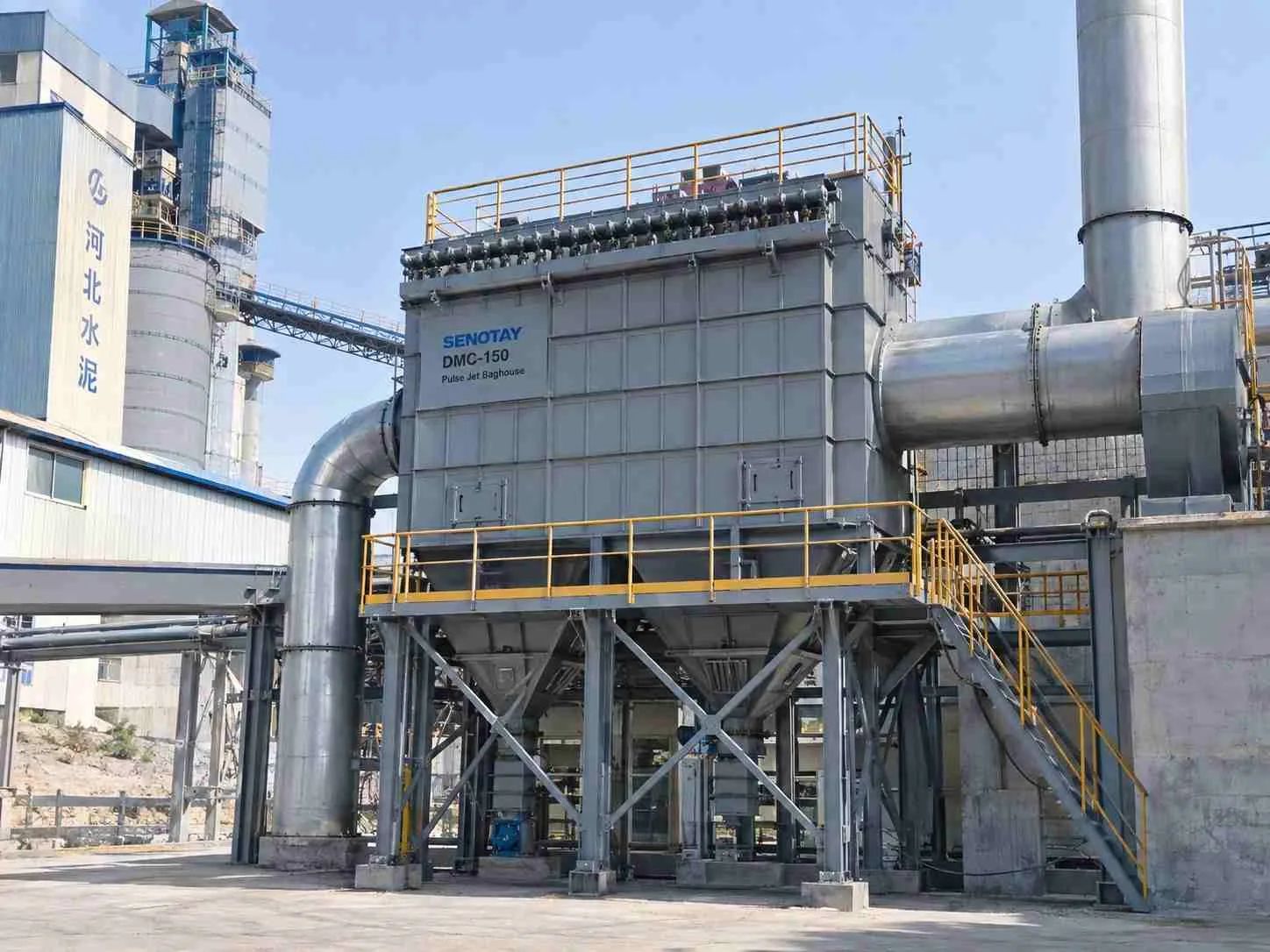
A mid-size cement grinding station in a Chinese key-region air-pollution control zone was blinding through felt filter bags and missing its 20 mg/m³ particulate limit. A Senotay DMC-150 offline pulse-jet PPC baghousewith PTFE-laminated media dropped outlet dust to a measured 8 mg/m³, with zero unplanned stoppages across nine months of operation.
A PPC offline pulse bag filter is a modular baghouse that isolates each chamber during cleaning, so compressed-air pulses never interrupt filtration in the other chambers. In this cement-grinding deployment, a Senotay DMC-150 unit — 120 m² filter area, 150 PTFE-laminated bags — cut outlet particulate from a baseline of 180 mg/m³ to a measured 8 mg/m³, comfortably inside the 20 mg/m³ regulatory ceiling for key-region cement plants under GB 4915-2013.
8 mg/m³ outlet particulate, down from a 180 mg/m³ baseline — measured by isokinetic stack sampling, ~96% reduction, against the 20 mg/m³ GB 4915-2013 key-region limit.
0 unplanned baghouse stoppages in 9 months, down from roughly one per month on the prior online-cleaning unit — plant maintenance log.
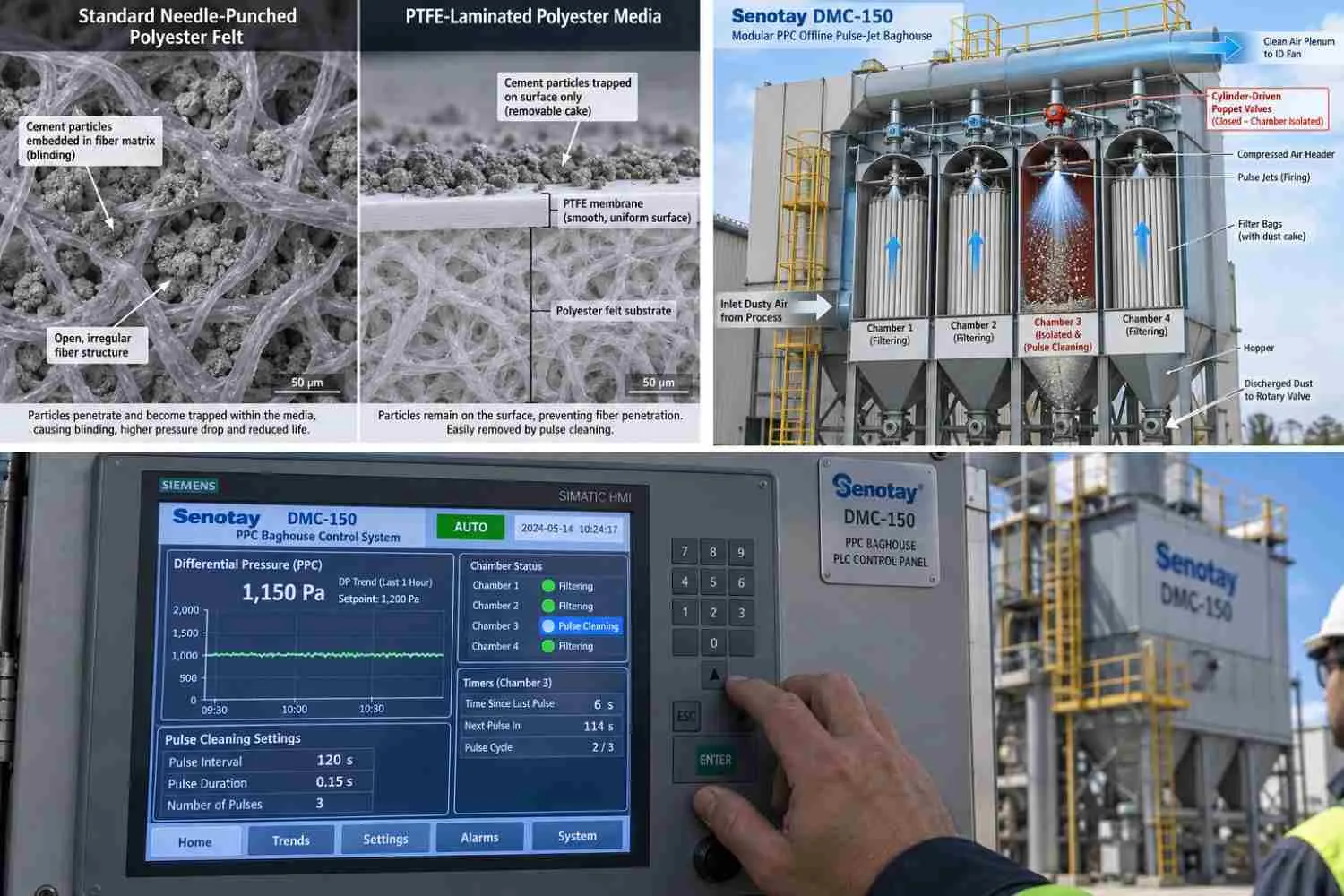
1,150 Pa average steady-state differential pressure, versus climbs past 1,800 Pa before scheduled bag changes on the old unit — logged Magnehelic gauge readings, consistent with the product's rated 1,000–1,600 Pa window.
~18% lower compressed-air draw per cleaning cycle than the prior online system (project estimate, not independently metered) — because offline chambers pulse only while isolated, never against live filtering airflow.
14 months in service on the original bag set with no replacements so far, against a rated 18–36-month service life for this media class.
The plant is a mid-size finish-grinding station — not a clinker line — producing roughly 1,800 t/day of cement through a closed-circuit ball mill, running three shifts with continuous production except for scheduled media changes. Dust points feed off the mill vent, a bucket-elevator transfer point, and the packing machine. The plant sits inside a designated key-region air-control zone, which puts it under the tighter of the two GB 4915-2013 particulate tiers, and its environmental team answers to provincial inspectors who run unannounced stack tests roughly every quarter.
Stack readings had crept from a compliant ~15 mg/m³ toward 180 mg/m³ over about 14 months as the plant's existing online-cleaning baghouse aged. A routine provincial inspection flagged the excursion, putting the line one repeat failure away from a production-halt order under its operating permit. The plant's first response was a like-for-like bag change on the existing unit — new felt bags in the same online-cleaning housing. Readings rebounded within about six weeks: the same fine raw-meal fraction that blinded the old bags reclogged the new ones almost as fast, because the cleaning architecture, not just the media, was the limiting factor. Two constraints ruled out a bigger rebuild: the compressed-air header was fixed at 0.5 MPa with no budget for a new compressor, and the replacement unit had to fit the existing structural steel platform and duct centerlines rather than a new footprint.
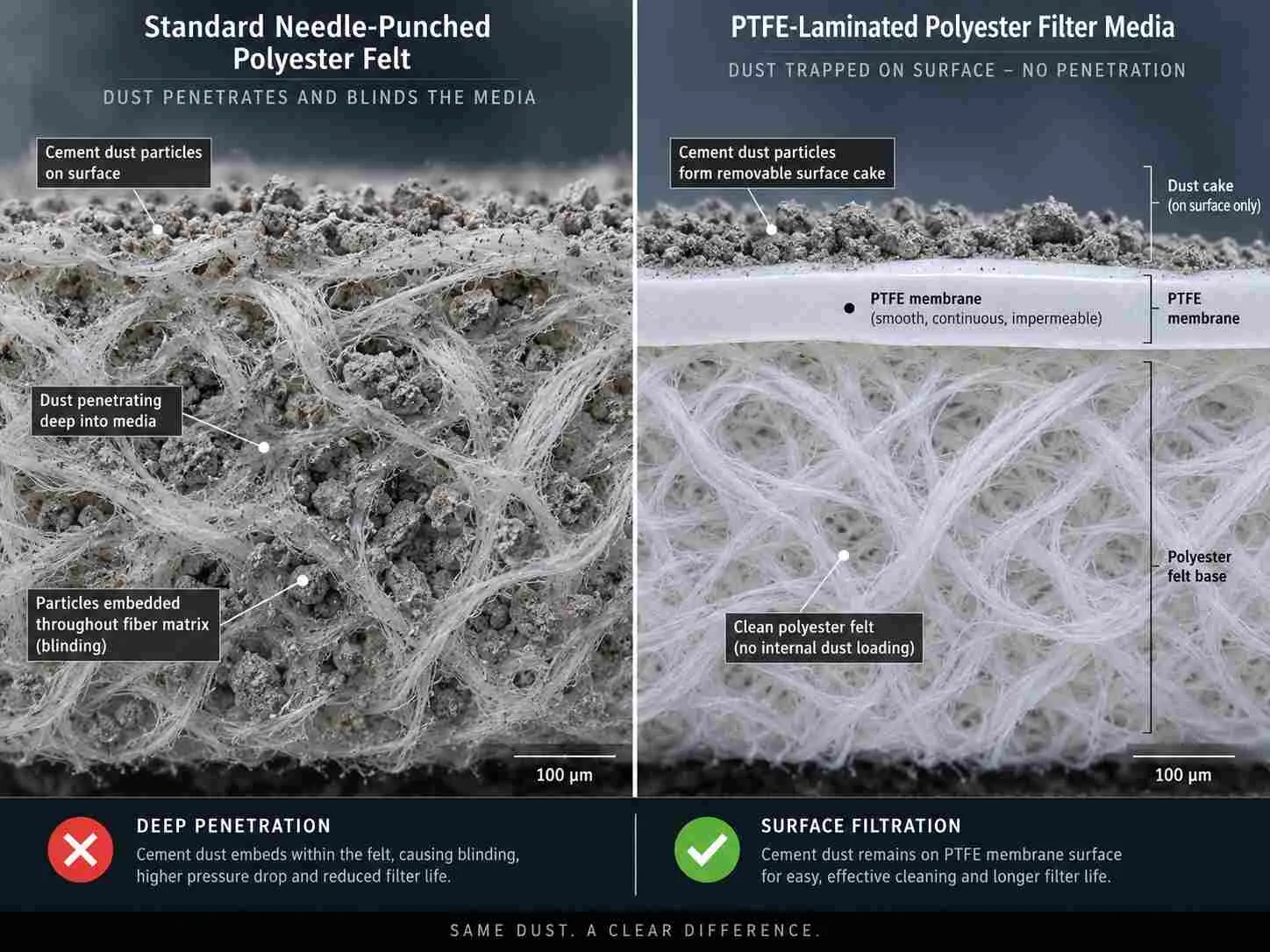
Blinding is when fine particles wedge inside a filter media's fiber matrix instead of sitting on its surface, so a compressed-air pulse dislodges the surface cake but cannot dig the embedded particles back out. Needle-punched polyester felt has a relatively open, irregular pore structure; cement dust in the 5–15 µm range packs into those pores, and differential pressure climbs even while spot efficiency readings still look acceptable, because the embedded fraction isn't what's being measured.
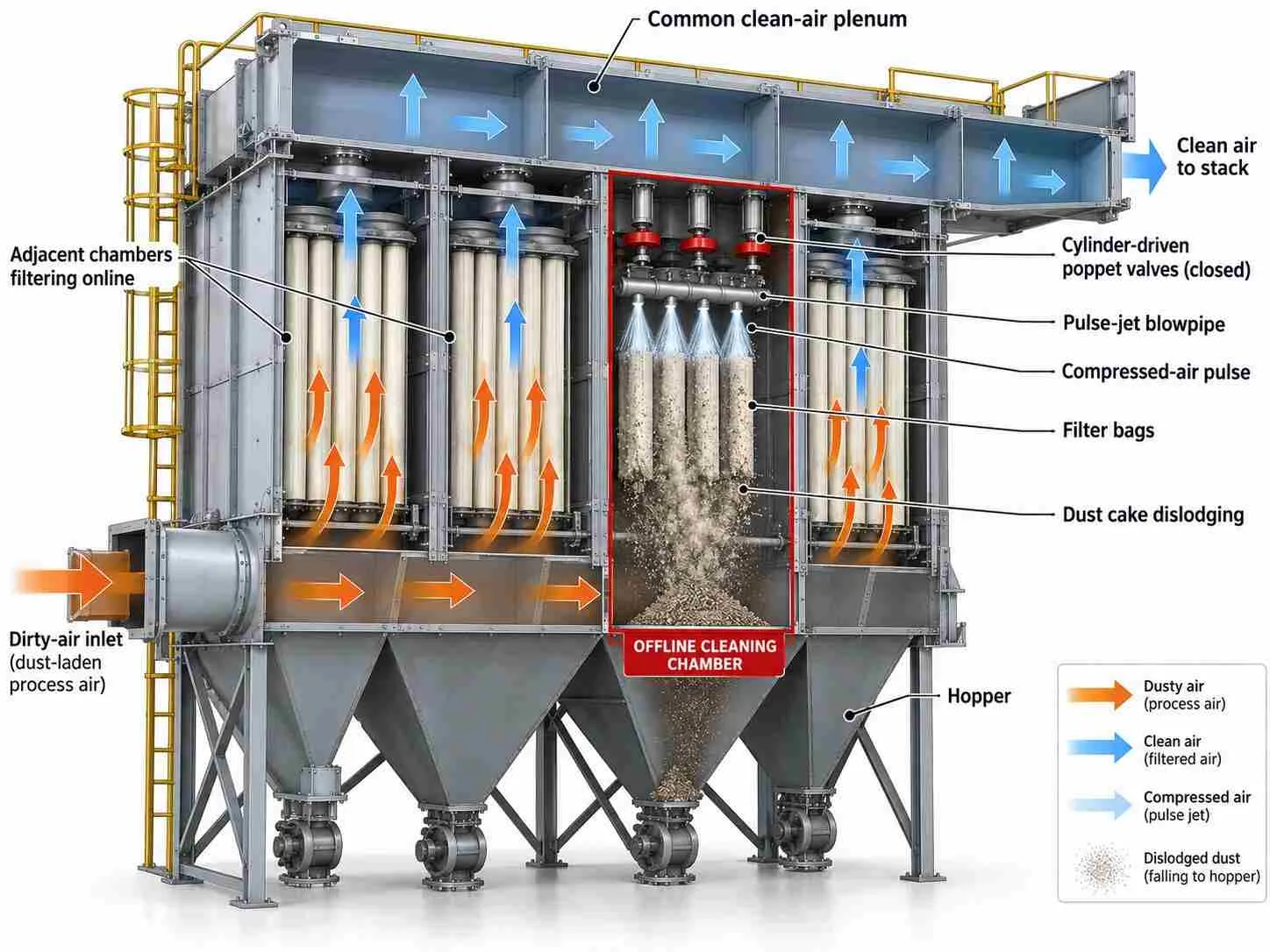
The cleaning architecture compounds this. In an online pulse-jet baghouse, one row of bags fires its cleaning pulse while the rest of the same chamber keeps filtering live airflow. The dislodged dust briefly enters that shared airstream — some resettles on adjacent bags, some carries straight through to the outlet, which is why online systems tend to show emission spikes timed to each pulse cycle rather than a flat baseline. An offline design closes a lifting (poppet) valve to fully isolate one chamber — cutting its filtering airflow to zero — before firing the pulse, so dislodged dust falls only into that chamber's own hopper with nothing to carry it forward. That's the mechanism behind the 20 mg/m³ vs. 30 mg/m³ split in GB 4915-2013's key-region and general-region limits: key regions effectively require cleaner-cycle architecture, not just better media.
The plant needed a fix that solved the emission problem without a new compressor or a structural rebuild — every added requirement had to work inside those two hard limits.
Re-bagging is the right call when a unit's cleaning architecture already meets the emission target and only the media has worn out — it wasn't the case here. Cartridge and ESP retrofits both reach the required emission level, but neither fit the existing duct and steel footprint without a construction project the plant hadn't budgeted; for a fine, blinding-prone dust that's already known to respond to felt or membrane bags, an offline pulse-jet baghouse sized to the existing envelope was the option that solved the actual constraint, not just the emission number.
The plant's engineering team had two competing baghouse quotes on the table — one from a local fabricator, one from an established multinational OEM. What they asked Senotay to prove, specifically, was that a DMC-150 sized to their exact duct centerlines would hold the existing structural platform's load rating without reinforcement, since neither alternative bid had run that check. Senotay supplied stamped structural loading calculations against the plant's existing drawings before the order was placed — not a lower price, but the only bid that closed the footprint risk in writing.
Senotay supplied one Senotay DMC-150 offline pulse-jet PPC baghouse dust collector, configured for the mill vent's duty and the plant's fixed footprint.
Configuration:
120 m² total filter area, 150 bags at 133 mm diameter × 2,000 mm length
PTFE-laminated polyester filter media
18.5 kW induced-draft fan
Offline chamber isolation via cylinder-driven lifting valves, PLC-timed pulse control
Rotary airlock for continuous dust discharge to an existing conveyor
Three decisions drove the configuration:
Chose the DMC-150 (120 m²) over the next size down, DMC-120 (96 m²), because the plant's verified duct airflow of 8,400 m³/h against DMC-120's smaller area works out to 8,400 ÷ 60 ÷ 96 ≈ 1.46 m/min air-to-cloth ratio — above the product's rated 0.8–1.4 m/min ceiling — while the DMC-150 keeps it at 8,400 ÷ 60 ÷ 120 ≈ 1.17 m/min, with headroom for dust loading swings.
Chose PTFE-laminated bags over standard needle-punched polyester felt because this mill's raw-meal fraction is fine enough to embed in felt's open pore structure (blinding), driving differential pressure up while spot efficiency still looked acceptable; the PTFE membrane's smoother surface layer keeps the dust cake on top of the media where the pulse can fully release it.
Chose 0.35 MPa pulse pressure — the upper half of the product's 0.3–0.4 MPa range — over the standard 0.3 MPa setting because a 2,000 mm bag needs deeper compressed-air penetration to fully clear cake from the lower third of the bag, and the plant's existing 0.5 MPa header supports it without a new compressor.
Standard vs. custom: the housing, bag cages, and control panel are Senotay's standard DMC-150 platform; the inlet/outlet flange positions and support-leg spacing were custom-matched to the existing duct centerlines and steel platform. The one trade-off accepted: running the pulse pressure at the top of its range increases compressed-air draw per cycle slightly versus the 0.3 MPa baseline, in exchange for reliably clearing the longer bags.
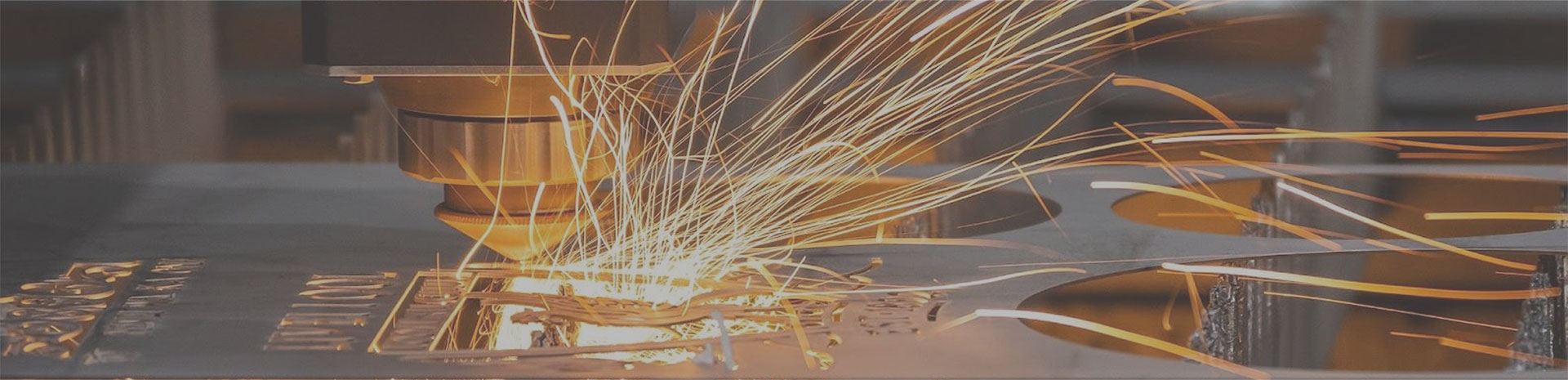
Housing panels were laser-cut from 6 mm Q235B steel and formed on a press brake, then MIG-welded into the dirty-air and clean-air chamber sections with continuous seam welds at the tube-sheet joints — the tube sheet is the highest-consequence weld on the unit, since a pinhole there lets raw dust bypass the bags entirely. Each completed housing section went through a high-pressure air-tightness test at ±5,000 Pa before the bag cages and PLC control panel were installed. Filter bags were cut and sewn to the 133 mm × 2,000 mm dimension from PTFE-laminated polyester roll stock, then fitted over galvanized-steel support cages and installed with the tube sheet's snap-ring seal — this seal fit was the step that took the most rework, since an uneven seal shows up later as a localized dust streak at the outlet rather than a clear leak test failure. Lead time ran roughly six weeks fabrication, two weeks factory testing and finishing, three weeks freight and site delivery.
Structural loading, housing air-tightness, and welding QC were in-house Senotay checks before shipment. The post-commissioning stack particulate test was run by a third-party environmental testing firm at the plant's request, since that's the result the provincial inspection would ultimately check against.
Installation ran inside the planned 72-hour window, completing at 48 hours. One issue came up during commissioning: the PLC's default pulse-cleaning interval, tuned for a lighter dust loading, was too long for this mill's dust concentration, letting differential pressure climb closer to 1,400 Pa before each cleaning cycle triggered. Senotay's commissioning engineer shortened the interval on site and verified the new setting held pressure in the 1,000–1,200 Pa band across a full shift. Handover included operator training on the PLC interface and bag-change procedure, the O&M manual, and a spares kit covering pulse valve diaphragms and a partial bag set.
Over the nine months of tracked operation, the plant has passed two unannounced provincial stack inspections without a follow-up notice — the metric that matters most for its permit standing. One thing nobody explicitly asked for: the reduced pulse frequency has also cut audible cleaning noise on the mill floor, a minor but noticed change for shift operators. One thing that did not improve: compressed-air header pressure still drops slightly during simultaneous cleaning of two adjacent chambers under peak dust loading, a known limitation of the fixed-header decision, though it hasn't affected cleaning performance to date. On a straightforward avoided-cost basis — no further inspection remediation, no repeat bag-and-fail cycle — the plant's environmental team estimates payback inside the original project timeline, though that figure wasn't independently audited for this report.
The governing calculation for any baghouse is the air-to-cloth ratio (A/C): the volume of air passing through each unit of filter media per minute.
A/C (m/min) = Airflow (m³/min) ÷ Total Filter Area (m²)
Worked example from this project: 8,400 m³/h ÷ 60 = 140 m³/min; 140 ÷ 120 m² ≈ 1.17 m/min. Keeping A/C inside a product's rated range — 0.8–1.4 m/min for this PTFE-laminated bag class — is what keeps differential pressure and bag life predictable; push past it and pressure drop climbs faster than the cleaning cycle can recover.
Before requesting a quote on any offline pulse-jet baghouse, establish these numbers first:
Actual duct airflow, measured by pitot traverse, not nameplate fan capacity — fan curves overstate real duct flow.
Dust particle size distribution and loading (g/m³) — this determines both the A/C ceiling you should target and whether felt or membrane media is justified.
Available compressed-air pressure and volume at the header nearest the unit — undersized supply is the most common cause of underperforming pulse cleaning.
Governing emission limit for your region and industry — in China this means checking whether your facility sits inside a GB 4915-2013 key-region or general-region zone, since the limit differs by a full 10 mg/m³.
Questions worth putting to any supplier, not just this one: what A/C ratio are they designing to, and is it inside the media manufacturer's own rated range for your dust type? Is the cleaning cycle offline or online, and why? What structural loading data do they have for a footprint-constrained retrofit versus a new-build?
The DMC series spans ten standard sizes from DMC-24 (19.2 m², 24 bags, 2.2 kW) up to DMC-200 (160 m², 200 bags, 30 kW), covering rated airflows from 1,152 m³/h to 19,200 m³/h. This project's DMC-150 configuration — 120 m² filter area, 150 bags, 18.5 kW, rated 7,200–14,400 m³/h — is one of ten standard sizes in the range, detailed on Senotay's PPC baghouse dust collector product page, with custom flange and support-leg positioning for this retrofit.
Q. What is a PPC offline pulse bag filter?
Ans: It's a modular baghouse dust collector that cleans one chamber at a time, fully isolating it from filtering airflow before firing a compressed-air pulse, which prevents dislodged dust from re-entering the outlet stream during cleaning.
Q. How is air-to-cloth ratio calculated for a baghouse?
Ans: Divide the airflow in m³/min by the total filter area in m². A properly sized unit for fine industrial dust typically runs 0.8–1.4 m/min; running above that range shortens bag life and raises differential pressure.
Q. What's the difference between online and offline pulse-jet cleaning?
Ans: Online cleaning pulses individual bag rows while the rest of the chamber keeps filtering live air; offline cleaning fully isolates the whole chamber first, so dislodged dust can't be carried to the outlet mid-cycle.
Q. How long do PTFE-laminated filter bags last on cement dust?
Ans: Typically 18–36 months depending on dust loading and operating hours, versus 8–14 months for standard felt bags on the same fine, blinding-prone dust fraction.
Q. Can a PPC baghouse retrofit into an existing duct footprint?
Ans: Yes, within limits — flange positions and support-leg spacing can be custom-matched to existing structural steel and duct centerlines, but the housing's own footprint and weight still need to be checked against the existing platform's load rating.
Q. What emission limit applies to cement plants in China's key regions?
Ans: Under GB 4915-2013, key-region cement facilities face a 20 mg/m³ particulate limit, compared with 30 mg/m³ for general regions — the tighter figure that made offline cleaning architecture, not just media upgrade, the deciding factor here.
Q. Does a bigger baghouse always mean better performance?
Ans: No — oversizing past the actual duct airflow just adds capital cost without improving emission results, and undersizing pushes the air-to-cloth ratio past the media's rated range, which is the more common and more damaging mistake.
For a grinding line facing a similar emission excursion, the fastest next step is a duct airflow verification (pitot traverse) alongside a dust particle-size check — both are needed before any supplier can size a unit correctly. Contact Senotay's technical teamfor a sizing review, or request a quote against your specific duct and permit numbers directly.
Related reading: LDMC baghouse dust collector for long-bag offline configurations in higher-airflow applications; Bag Dust Collector for standard online-cleaning baghouse options; Cartridge Dust Collector as an alternative media format for lower-airflow, space-constrained sites; Senotay's quality control and certifications page for the ISO 9001/CE documentation referenced in this report.