
EN
What are you looking for?
A chemical plant’s scrubber controlled bulk gas absorption but left residual sulfuric acid aerosol. This representative application examines a Wet Electrostatic Precipitator polishing stage, an illustrative 40-to-4 mg/Nm³ reduction, and the measurements needed to substantiate that result.
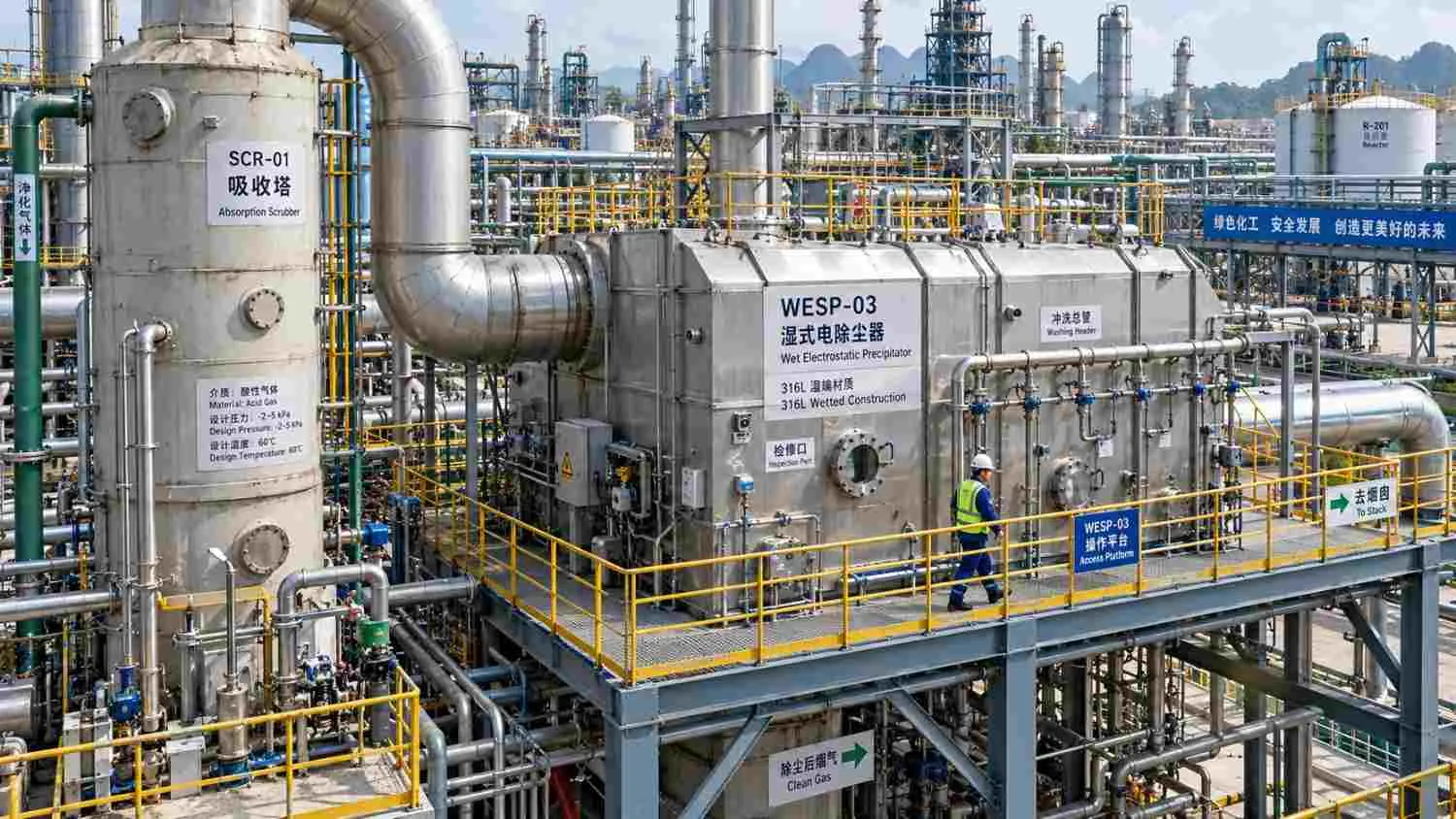 Can a wet ESP remove acid mist after a scrubber?
A wet ESP can capture acid droplets that remain after a scrubber, provided the aerosol, gas flow, temperature and corrosion conditions match its design. The electrical field moves charged droplets onto wetted collecting surfaces. Gas-phase acid removal still requires appropriate absorption. In this illustrative chemical-plant case, the proposed acceptance target is 5 mg/Nm³; actual compliance requires permit-specific testing and documented operating conditions.
The comparisons below are scenario inputs, not test findings. The proposed baseline period is 1–7 June 2026; the comparison period is 1–7 July 2026.
The representative customer processed sulfur-bearing chemicals and exhausted wet gas through an existing absorption system. Production demand varied with batch transfers, while ventilation continued between batches. The environmental manager owned the emissions records; the maintenance supervisor inherited duct deposits, blocked drains and difficult access.
The assumed ventilation duty was 30,000 actual m³/h at 55 °C.
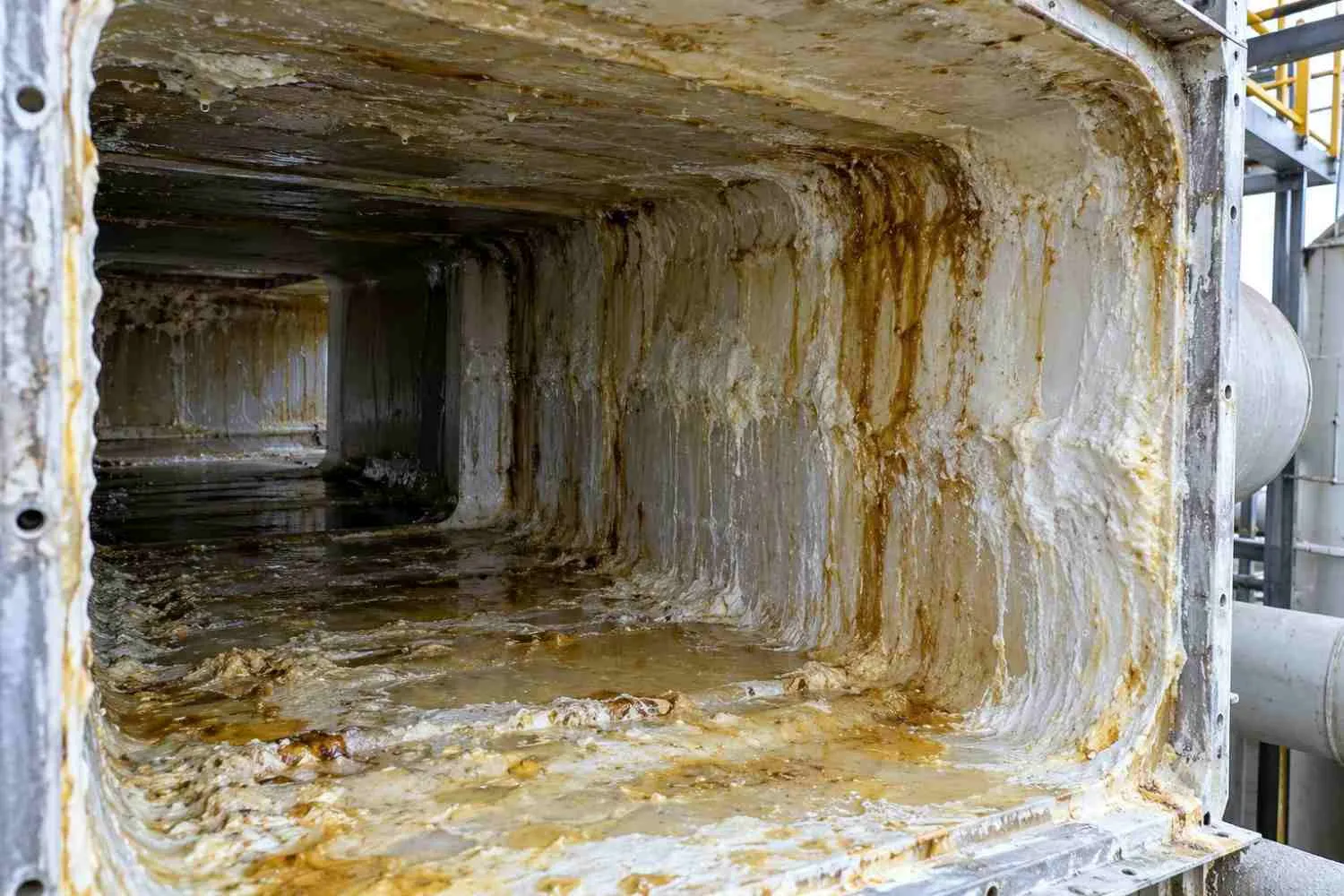
The plant’s illustrative problem began with recurring wet deposits downstream of the scrubber. Operators noticed that deposits returned even when the circulation pump, liquor chemistry and absorption duty appeared normal.
The team first cleaned the existing mist eliminator and restored its spray distribution. That intervention addressed obstructed passages and coarse liquid carryover, but it did not establish whether the remaining material was fine sulfuric acid aerosol. Increasing wash flow without diagnosing the aerosol risked adding liquid entrainment while leaving the original problem intact.
Repeated cleaning consumed maintenance time and interrupted the extraction system. Deposits also obscured whether corrosion originated in the process, scrubber or downstream condensation.
The awkward constraint was the retained upstream system. Its absorption function remained necessary, the available fan margin was limited, and the wastewater plant could not accept an unspecified new acidic stream. Any intervention had to respect all three boundaries.
Electrostatic precipitation moves charged aerosol across the gas stream toward a collecting surface. The gas does not have to pass through fabric, and a droplet need not strike a mesh strand by inertia. Water carries deposited material away from the collecting surface. EPA describes the charging and collection mechanism in its electrostatic precipitator engineering chapter.
An aerosol is a suspension of liquid droplets or solid particles in gas. Absorption is transfer of a gaseous species into a liquid. These definitions matter because a measured acid concentration can represent a different treatment problem depending on its physical form.
A coarse-droplet separator depends strongly on droplet motion relative to its internal surfaces. Small droplets can follow the turning gas stream and escape contact. An electrical collector introduces a force that moves charged droplets out of that stream.
Water washing also changes the maintenance problem. Captured acid must leave through a controlled liquid route; it cannot accumulate indefinitely on electrodes. Patchy wetting, plugged drains or contaminated insulation can therefore undermine performance even when the fan continues running.
A white plume is not a quantitative acid measurement. Condensed water can remain visible after effective aerosol removal, while a less visible stream can still contain pollutants. The useful acceptance question is the outlet acid concentration at a defined gas basis and process load, supported by a suitable sampling method.
The representative specification separated acceptance requirements from preferences. The concentration target applied to the agreed analytical acid fraction, not to every pollutant or to visible plume colour. Before purchase, the owner would need to identify the installation jurisdiction, applicable permit and legally required reporting basis. The following values are project assumptions, not regulatory quotations.
These alternatives compare treatment functions rather than interchangeable efficiency labels.
The cheaper repair wins when damaged demister internals caused the carryover. A fibre bed deserves a serious comparison for a largely liquid acid mist stream; it may avoid high-voltage equipment. The proposed WESP is the wrong answer when the dominant unresolved pollutant is gaseous SO₂, when safe electrical operation cannot be established, or when wastewater handling is unavailable. No option should be selected before inlet characterization distinguishes those cases.
For this scenario, the proposed decision package would include a signed duty sheet, corrosion assessment, fan check and acceptance protocol. The buyer should require the supplier to state what happens when inlet loading, temperature or flow exceeds the guaranteed envelope. A qualified exclusion is more useful than an unconditional efficiency claim unsupported by a test basis.
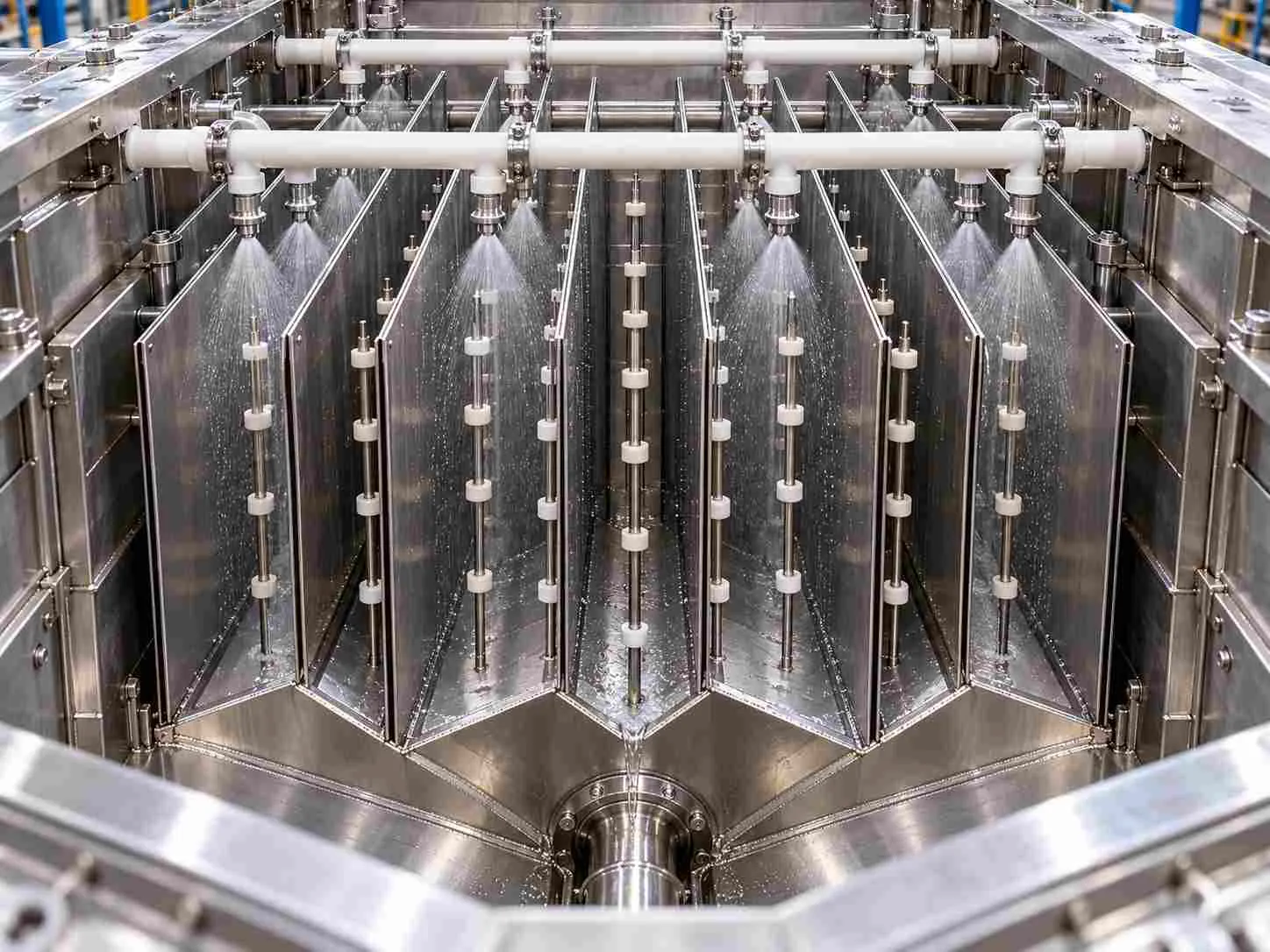
In the illustrative design, we supplied the WESP-03 plate configuration listed on Senotay’s wet ESP product page. This describes a representative supply scope, not a confirmed shipment.
The proposed package comprised:
A collecting section downstream of the retained absorption system.
316L wetted construction, subject to a duty-specific corrosion assessment.
A controlled high-voltage supply and protected insulator compartments.
Distribution internals, washing headers, drains and accessible inspection points.
Temperature, liquid-flow and electrical monitoring with agreed interlocks.
We chose electrical polishing → over more scrubber wash flow → because the assumed 40 mg/Nm³ residual required aerosol-specific investigation and a 5 mg/Nm³ outlet target. Additional water could not substitute for identifying how fine droplets escaped collection.
We chose a 400 Pa equipment pressure budget → over an unrestricted high-energy retrofit → because retained extraction capacity was a hard requirement at 30,000 actual m³/h. The final fan check would include new ducts and fittings separately.
We chose corrosion review at 55 °C → over accepting “316L” as sufficient evidence → because material suitability depends on acid concentration, contaminants and temperature together. The catalogue grade alone does not establish service life.
The model designation anchors the selection. Connections, support loads, distribution details, drainage routing and control interfaces remain project-specific engineering.
The accepted trade-off was additional electricity, liquid management and electrical maintenance in exchange for a plausible route to lower aerosol discharge. The system would retain its upstream absorption duty. Its installation would not eliminate plume visibility or make combustible gas safe.
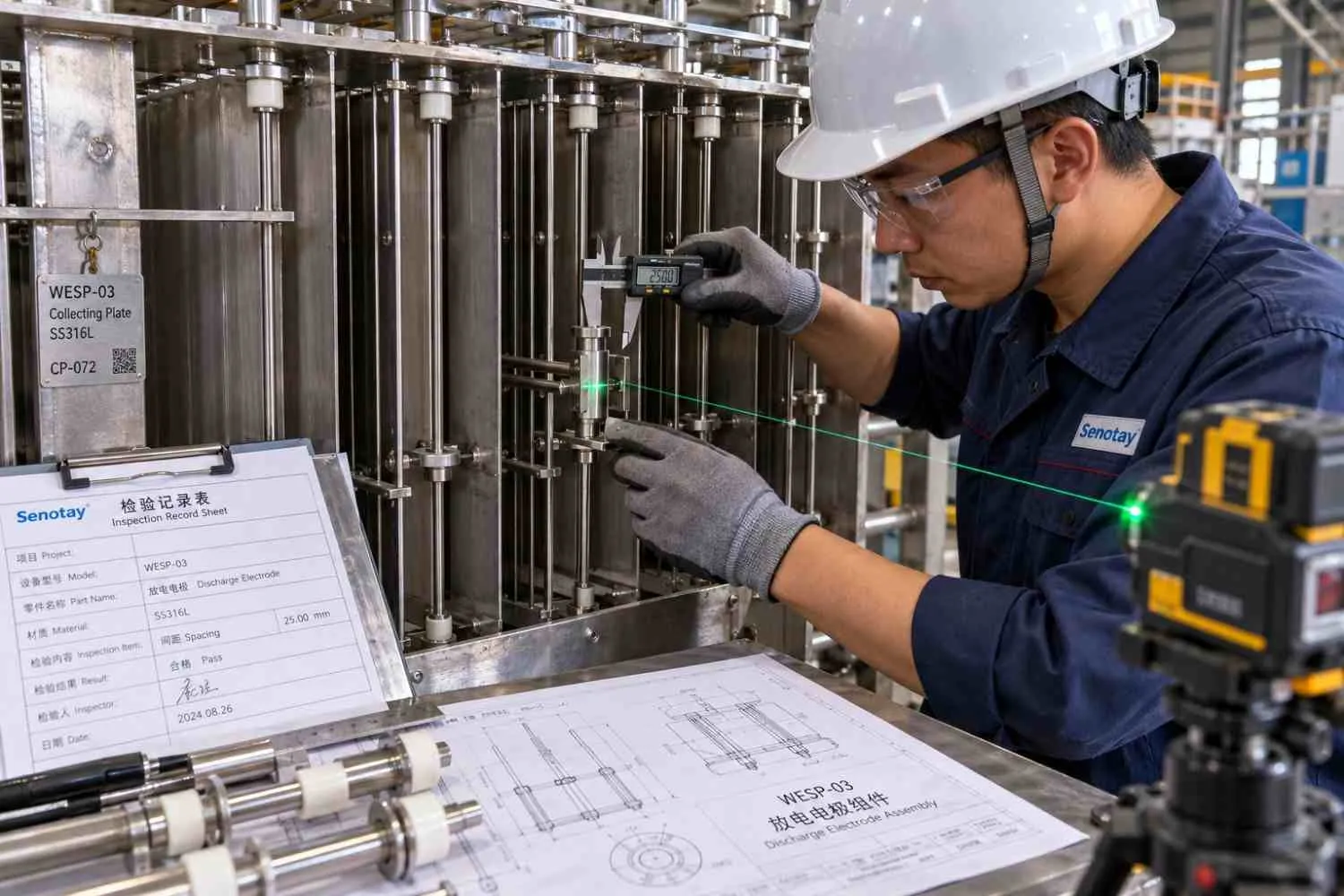
The following is a proposed build route; factory travellers and inspection reports have not been supplied. Senotay’s factory informationprovides company context, but does not prove that the operations described here occurred for this project.
The route begins with traceable 316L sheet and electrode material, followed by cutting, forming and preparation of assembly fixtures. A CNC cutting system would produce repeatable profiles; its actual thickness capacity and positional accuracy must come from the manufacturing plan. A press brake would form stiffeners and casing sections within its documented capacity.
We would join the casing using a qualified procedure, record weld inspection and check distortion before fitting the collecting assembly. The proposed electrode alignment tolerance is ±2 mm relative to the approved drawing, verified with a surveyed reference and calibrated dimensional tools. This is a project assumption, not a published WESP-03 tolerance.
Surface cleaning would remove fabrication contamination using an approved procedure compatible with the material. Assembly would then add washing headers, insulator protection, electrical connections and instruments.
The illustrative 10-week programme allocates 2 weeks to design and procurement, 5 weeks to fabrication, 2 weeks to assembly and checks, and 1 week to packing. Maintaining electrode alignment after joining is the anticipated difficult operation. The actual hardest step, rework count and number of assembly attempts remain unverified and must come from production records.
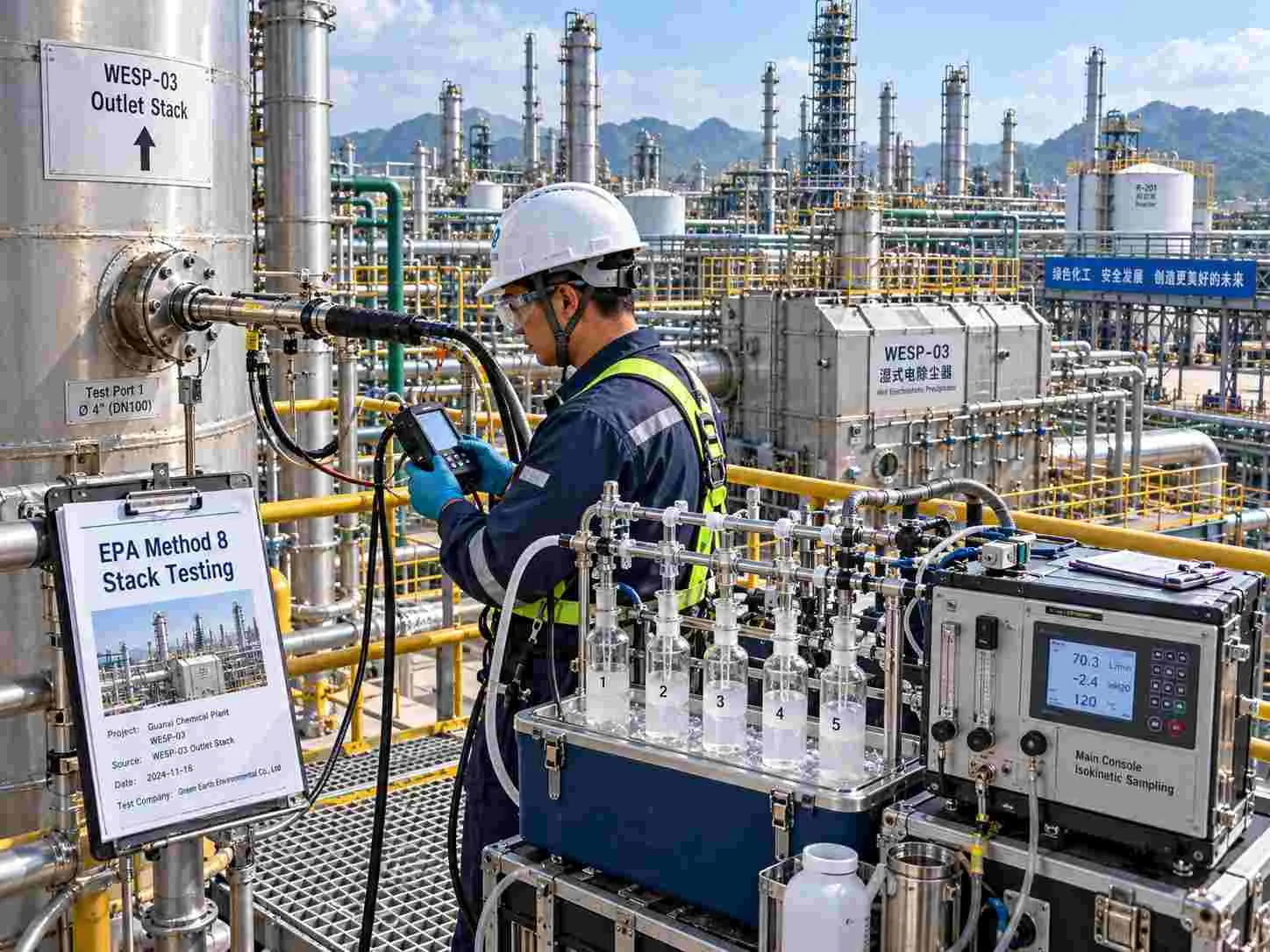
EPA Method 8 measures sulfuric acid, including mist and SO₃, separately from SO₂ using isokinetic stack sampling and chemical analysis. It is a measurement method, not a universal emission limit. Its stated interferences include fluorides, free ammonia and dimethyl aniline; the testing organization must assess applicability.
For the representative contract, an independent testing organization would sample matched inlet and outlet conditions over 3 runs of 60 minutes each. That duration is proposed, not a Method 8 universal requirement. A failed acceptance campaign triggers investigation, correction and retesting; statutory consequences depend on the actual permit.
Senotay’s quality-control page is not a substitute for project documents.
The illustrative installation problem was liquid backing up at a drain connection during the initial water trial. The commissioning team corrected the routing before energizing the collection section. This event is a representative failure scenario, not a recorded site incident.
Commissioning would establish gas flow, wash coverage and stable electrical operation before collecting acceptance samples. The team would test loss-of-liquid and access interlocks using an approved procedure, then record normal operating readings for maintenance staff.
Handover would include operating limits, isolation instructions, drawings, instrument checks, wash-system spares and an agreed fault-response procedure.
The same proposed methods apply to the baseline week, 1–7 June 2026, and comparison week, 1–7 July 2026. None of these values comes from a supplied project record.
The concentration reduction is calculated: (40 − 4) ÷ 40 × 100 = 90%. It describes the hypothetical comparison, not demonstrated equipment efficiency. Actual inlet/outlet removal efficiency requires paired measurements and correction for gas-flow differences where relevant.
The unpromised benefit in the scenario is easier inspection because downstream surfaces accumulate less material. The thing that does not improve is energy demand: the additional package consumes electricity. Plume appearance also remains outside the guarantee.
Commercial evaluation should value recovered production time only where production can use it. Cleaning savings should use actual labour rates, while power, water, wastewater treatment and replacement parts belong on the cost side. Without installed cost and verified operating records, a payback period would be invented.
"Adding the WESP-03 polishing stage gives us a clear conceptual route to capturing the fine acid aerosol escaping our current scrubber, but we will need to verify actual collection efficiency, wash-water performance, and drainage routing under our continuous operating conditions before final sign-off."
—Mr.Wang , Environmental Compliance Manager.
Specific collecting area relates installed collection surface to actual gas flow. EPA’s engineering chapter uses collection area and effective migration velocity in ESP sizing; neither parameter should be inferred from a model’s nominal capacity.
Use plain-text calculations:
Specific collecting area = A ÷ Q
Idealized removal fraction = 1 − exp(−w × A ÷ Q)
Here, A is effective collecting area in m²; Q is actual gas flow in m³/s; w is effective migration velocity in m/s; and exp means the exponential function. Specific collecting area has units of m²/(m³/s). The idealized equation is a screening model, not an acceptance guarantee.
For an illustrative area of 300 m² and flow of 30,000 actual m³/h:
Q = 30,000 ÷ 3,600 = 8.333 m³/s.
Specific collecting area = 300 ÷ 8.333 = 36 m²/(m³/s).
To screen for 90% removal, the implied migration velocity is:
w = −ln(1 − 0.90) ÷ 36 = approximately 0.064 m/s.
The 300 m² area is hypothetical; Senotay does not publish it for WESP-03. The calculated velocity is a requirement of the assumed model, not a measured aerosol property. A supplier must justify its design using relevant duty evidence.
Obtain maximum actual flow and temperature; inlet acid concentration and aerosol-size information; gas and liquid chemistry; and the outlet limit with its measurement basis. Normalized dry concentration cannot be multiplied directly by actual wet flow to obtain pollutant mass rate.
Ask every supplier for effective collection area, flow-distribution assumptions, corrosion evidence, wash-water balance and the performance exclusions. Require access for representative sampling.
Maintenance should track operating trends against a documented healthy baseline. EPA’s ESP monitoring guidanceidentifies electrical operating parameters, outlet indicators and gas conditions as useful performance information. None alone proves acid compliance.
Do not treat repeated reset success as proof that a fault has disappeared. Record the sequence of electrical, liquid and process changes before intervention. High-voltage isolation, discharge and grounding require the approved procedure and qualified personnel; stopping the fan alone does not establish safe access.
Senotay publishes the following type table; efficiencies are catalogue claims, not this project’s results. Abbreviated material labels are retained where the supplier does not identify a grade.
The representative selection is WESP-03. Its collecting area, dimensions, electrical consumption and water demand need a signed schedule. In the linked product page’s type table, this configuration is one of 10 in the range.
Ans: A WESP should not be purchased as the principal SO₂ absorption system. Its proposed role here is aerosol polishing downstream of existing absorption. Any incidental gas removal must be measured separately and cannot support a gas-removal guarantee without an appropriate design and test basis.
Ans: No; the grade name alone does not establish corrosion resistance for the actual duty. Acid strength, temperature, chlorides and other contaminants must be assessed together. The representative selection retains a corrosion-review hold point before fabrication, even though the published model lists that material.
Ans: No; the resulting outlet concentration depends on inlet loading, pollutant definition and operating conditions. A percentage without those boundaries cannot establish a concentration guarantee. This scenario uses a separate contractual target and requires testing at agreed production conditions, with results on a consistent gas-volume basis.
Ans: Not necessarily, because condensed water can remain visible after acid aerosol collection. Plume colour is therefore unsuitable as the sole acceptance criterion. Specify the acid fraction, measurement method and concentration limit, and assess visible plume requirements separately if the local permit or neighbouring receptors require them.
Ans: A defensible price requires the gas duty, chemistry, layout, utilities and acceptance scope. No project quotation was supplied. Compare installed cost together with electricity, water treatment, testing and maintenance; include upstream equipment that must remain operating. The illustrative programme and electrical demand are assumptions awaiting supplier confirmation.
For an initial review, send existing test reports and gas conditions. For a quotation, add drawings, utilities and the proposed guarantee to Senotay’s enquiry form. Request a scope review within 2 working days; that response target requires supplier agreement.
Related reading:
PP spray tower: compare gas absorption with aerosol collection.
Dry horizontal ESP: review the different cleaning route for dry particulate.
Senotay application cases: request a documented chemical-plant reference and a WESP reference from another industry; neither was supplied for this draft.