
EN
What are you looking for?

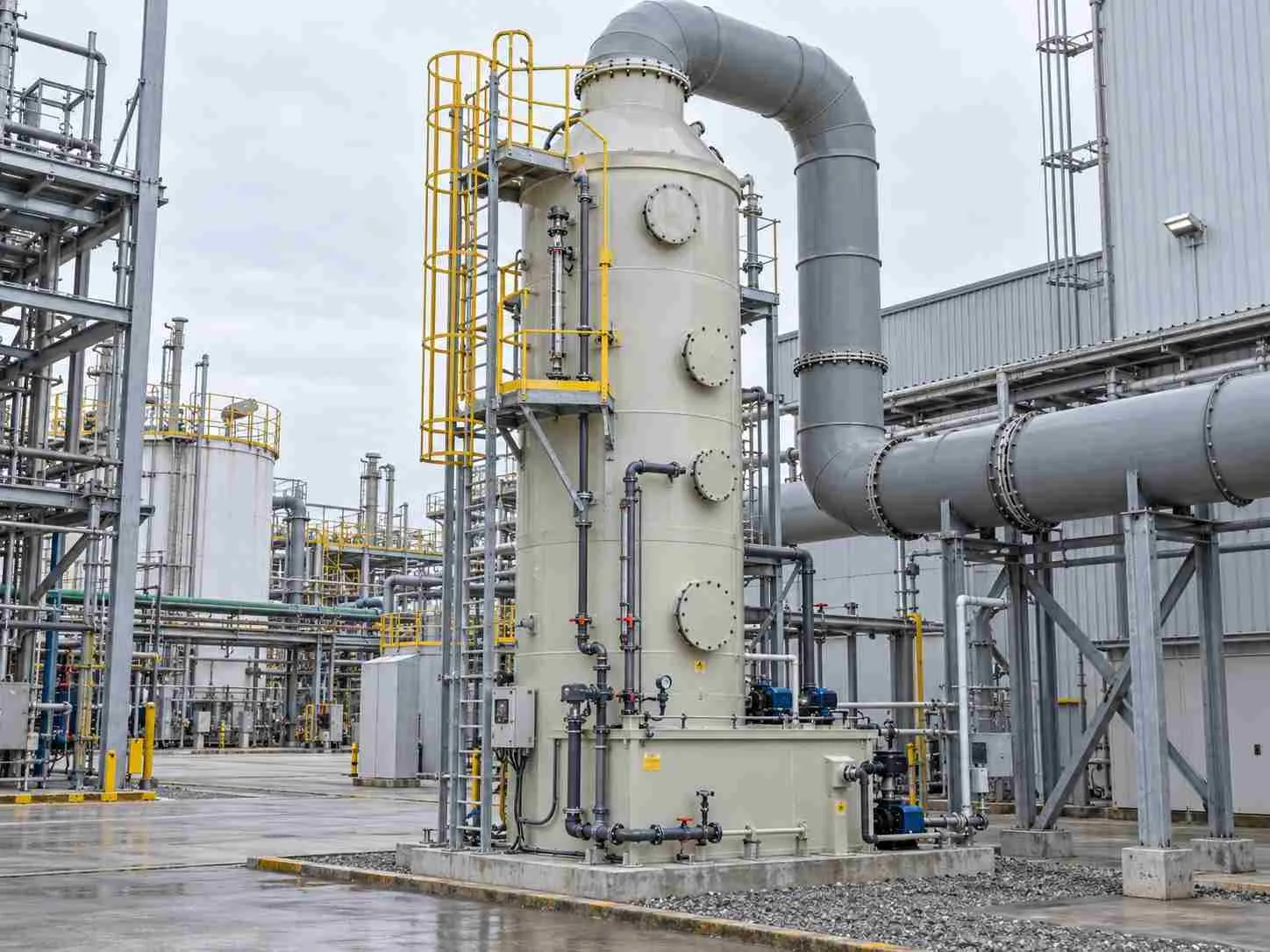
A chemical plant needed steadier hydrochloric acid fume control during batch transfers. This representative PP Spray Tower application examines a Type 7 packed scrubber, an illustrative outlet change from 80 to 8 mg/Nm³, and the operating checks behind credible performance acceptance.
A polypropylene spray tower controls soluble acid gases by contacting contaminated air with circulating liquid. For hydrochloric acid, alkaline dosing neutralizes absorbed acid while wetted packing provides contact area. A demister limits liquid carryover. This representative chemical-plant design targets an HCl outlet concentration of 10 mg/Nm³, supported by defined airflow, liquid circulation, reagent control and an agreed emissions-testing procedure.
These scenario comparisons use a baseline week of 1–7 June 2026 and a comparison week of 1–7 July 2026. No measurements are available.
The representative plant prepared aqueous chemical formulations and transferred hydrochloric acid between storage and process vessels. Ventilation operated throughout production, but pollutant loading rose during charging and transfer. The assumed extraction duty was 24,000 actual m³/h at 35 °C.
The environmental manager needed defensible outlet results. The production supervisor wanted fewer fume-related interruptions, while maintenance staff wanted instruments they could inspect and clean without dismantling the liquid circuit. The equipment had to work through changing acid loads rather than only under steady conditions selected for a demonstration.
The existing treatment system did not maintain consistent outlet conditions during the representative batch-transfer cycle. Operators saw stable readings between transfers, followed by periods that required manual intervention. The problem was difficult to diagnose because the sump condition did not necessarily describe the liquid reaching every part of the packing.
The first response was to increase alkaline dosing and clean accessible spray nozzles. That helped restore parts of the liquid circuit but did not establish uniform wetting across the bed. More reagent could correct exhausted liquor; it could not make gas contact a dry section of packing.
Leaving the problem unresolved meant continued operator attention, possible production restrictions and uncertainty over the next emissions campaign.
The awkward constraint was the existing extraction network. The plant could not accept a pressure increase that weakened capture at the vessels. Wastewater treatment also had limited room for unplanned blowdown.
Absorption transfers a gaseous pollutant into a liquid. Neutralization reacts the absorbed acid with a base. A demister separates entrained droplets; it does not remove water vapour. These distinct functions explain why a clean-looking sump, a running pump and an unobstructed stack do not independently prove HCl removal.
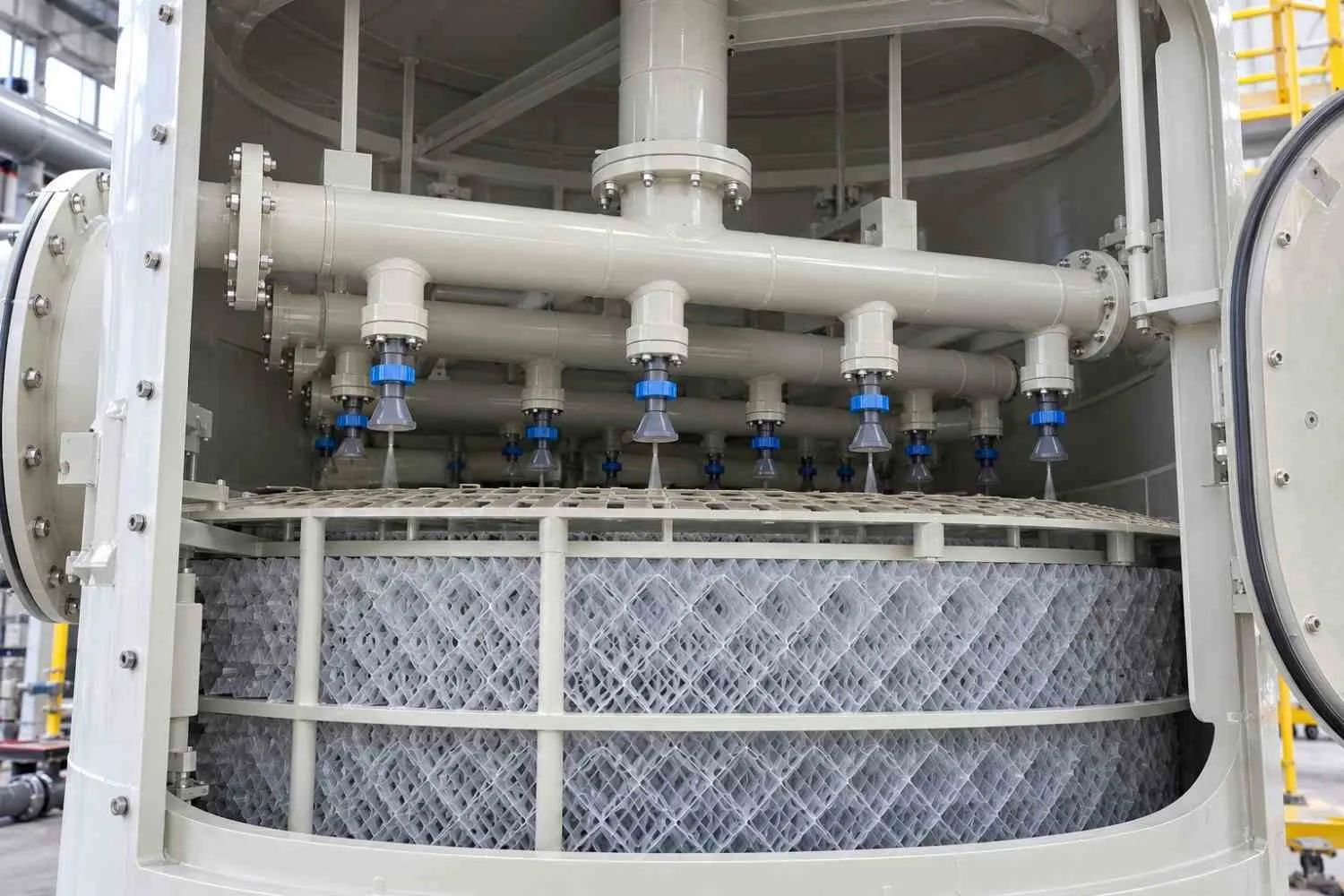
The EPA wet-scrubber engineering manualdescribes packed absorbers as gas–liquid contact equipment whose design depends on the gas and liquid conditions. Packing spreads the liquid across exposed surfaces. Gas moving through the bed can then contact that liquid rather than pass through empty, poorly wetted channels.
For the selected chemistry, the simplified reaction is:
HCl + NaOH → NaCl + H₂O
Neutralization consumes absorbed acid and helps sustain absorption. However, a satisfactory pH reading in the tank cannot prove that circulation reaches every nozzle or that the gas is distributed evenly.
Salt remains in the liquid after neutralization. Recirculation saves water but does not remove this accumulating dissolved material. Blowdown and makeup must therefore follow an established liquid balance rather than an assumption that the same liquor can circulate indefinitely.
When outlet performance deteriorates, inspect contact and chemistry separately: flow distribution, packing condition, reagent availability and liquid composition. Increasing caustic feed before checking circulation can raise chemical consumption without correcting the actual failure.
The representative acceptance specification separates mandatory limits from desirable operating improvements. The outlet target applies to HCl on a defined reporting basis; it is not a claim about every compound in the exhaust. Local regulatory applicability remains unresolved until the installation location, process category and permit are known.
The alternatives address different causes and should be compared against the measured pollutant and existing equipment condition.
Repair is the economical choice when the existing vessel has sufficient contact capacity and the real faults are blocked distribution or failed instrumentation. Water-only absorption deserves evaluation where acid recovery or a suitable liquid balance makes sense. A packed alkaline tower is inappropriate for an untreated heavy solids load, incompatible solvents or temperatures beyond its approved design.
No purchase record establishes why an actual customer chose Senotay. In this representative selection, the buyer required an operating envelope that included transfer peaks, not just average gas flow. The evidence package would contain a hydraulic calculation, packing schedule, chemistry assessment and acceptance plan.
For the representative case, we selected the Type 7 configuration from Senotay’s polypropylene scrubber range. The following supply description is illustrative, not confirmation that equipment was manufactured or delivered.
The proposed package included:
A PP-H shell using an approved resin grade, with packing supports and service access.
A packed contact section, liquid distributor and accessible spray headers.
Recirculation pumping with measured flow and a low-flow alarm.
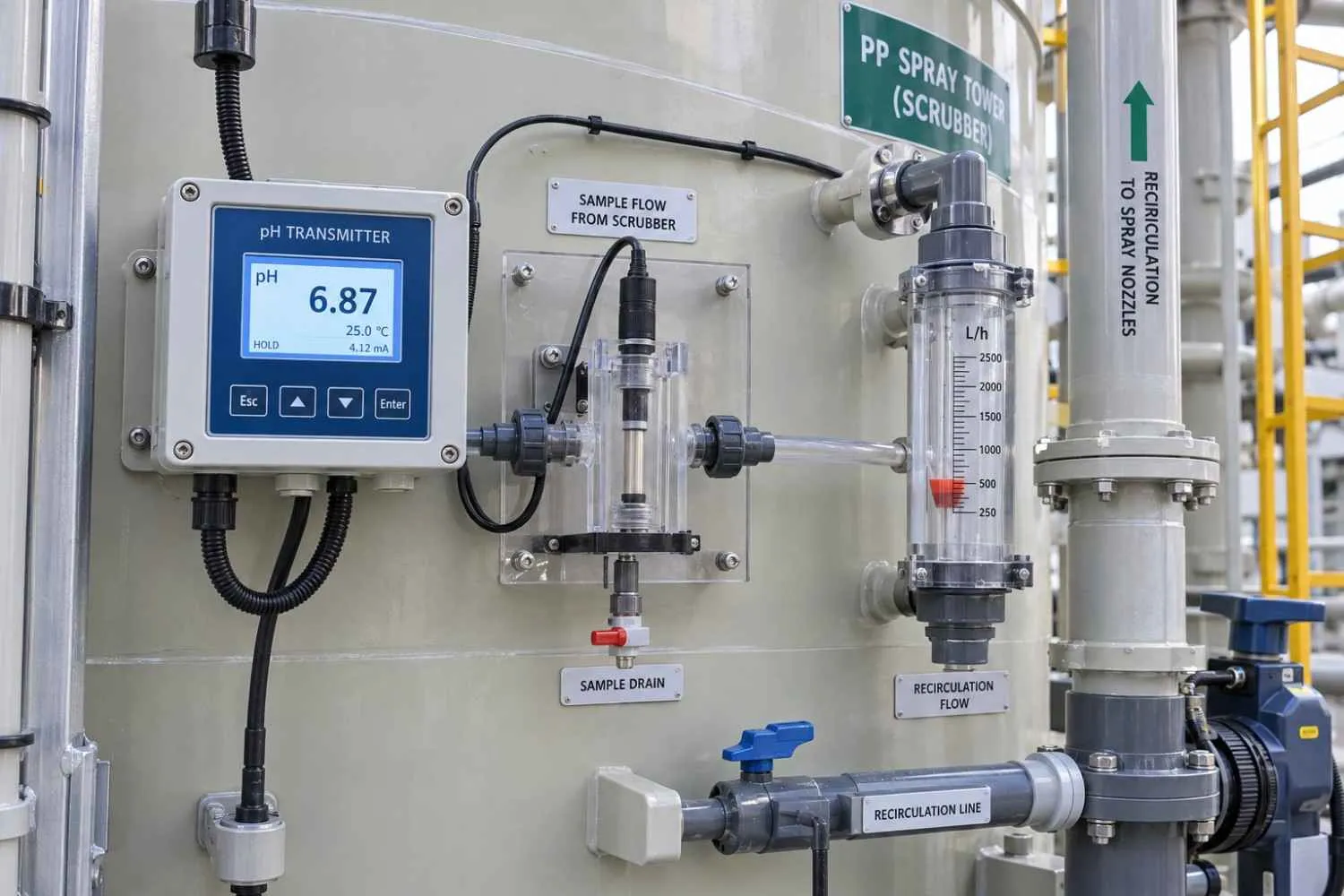
Sodium hydroxide dosing, a serviceable pH sensor and controlled mixing.
A demister with drainage access, plus makeup and blowdown connections.
We chose the 2,200 mm Type 7 diameter → over the 2,000 mm Type 6 diameter → because the assumed 24,000 m³/h duty falls inside Type 7’s published 21,000–25,000 m³/h range. Hydraulic suitability still requires checking the selected packing and liquid rate.
We chose measured 72 m³/h recirculation → over selecting a pump only by motor rating → because the assumed liquid-to-gas ratio of 3 L/m³ requires that flow at 24,000 m³/h. The pump must deliver it at the actual system head, not merely on an unrestricted test line.
We chose feedback dosing with an initial pH 7.5–8.5 control band → over fixed-rate addition → because the representative inlet load changes during batch transfers.
The catalogue identifies the equipment family and type. The packing depth, liquid distributor, nozzle arrangement, structural thickness, polymer resin grade, seals and instrument interfaces require an approved project schedule. PP-H is a material designation, not a complete procurement specification.
The accepted trade-off was continued reagent consumption and saline wastewater generation. The project sought steadier fume control, not elimination of the liquid-treatment obligation. A working demister would also leave the discharged gas humid.
The manufacturing route below is proposed; no factory traveller was supplied. Senotay’s factory informationprovides company context but does not verify this project’s fabrication history.
Fabrication starts with traceable PP-H and compatible consumables. Cutting and forming establish the shell sections, access openings and support geometry.
The fabricator would join sections using approved thermoplastic welding procedures, fit packing supports and inspect accessible welds before closing the vessel. The proposed nozzle-position tolerance is ±3 mm against the approved drawing, checked using calibrated dimensional tools. This is a representative project criterion, not a published catalogue tolerance.
Surface preparation involves cleaning and joint preparation rather than a corrosion-protection paint system on the wetted polymer. Assembly then adds packing, headers, demister, instruments and pipework.
The illustrative 8-week programme allocates 2 weeks to engineering and procurement, 3 weeks to fabrication, 2 weeks to assembly and testing, and 1 week to packing. Distributor alignment is the anticipated difficult operation because uneven delivery can leave parts of the bed dry. Actual attempt counts and any rework remain unknown and must come from manufacturing records.
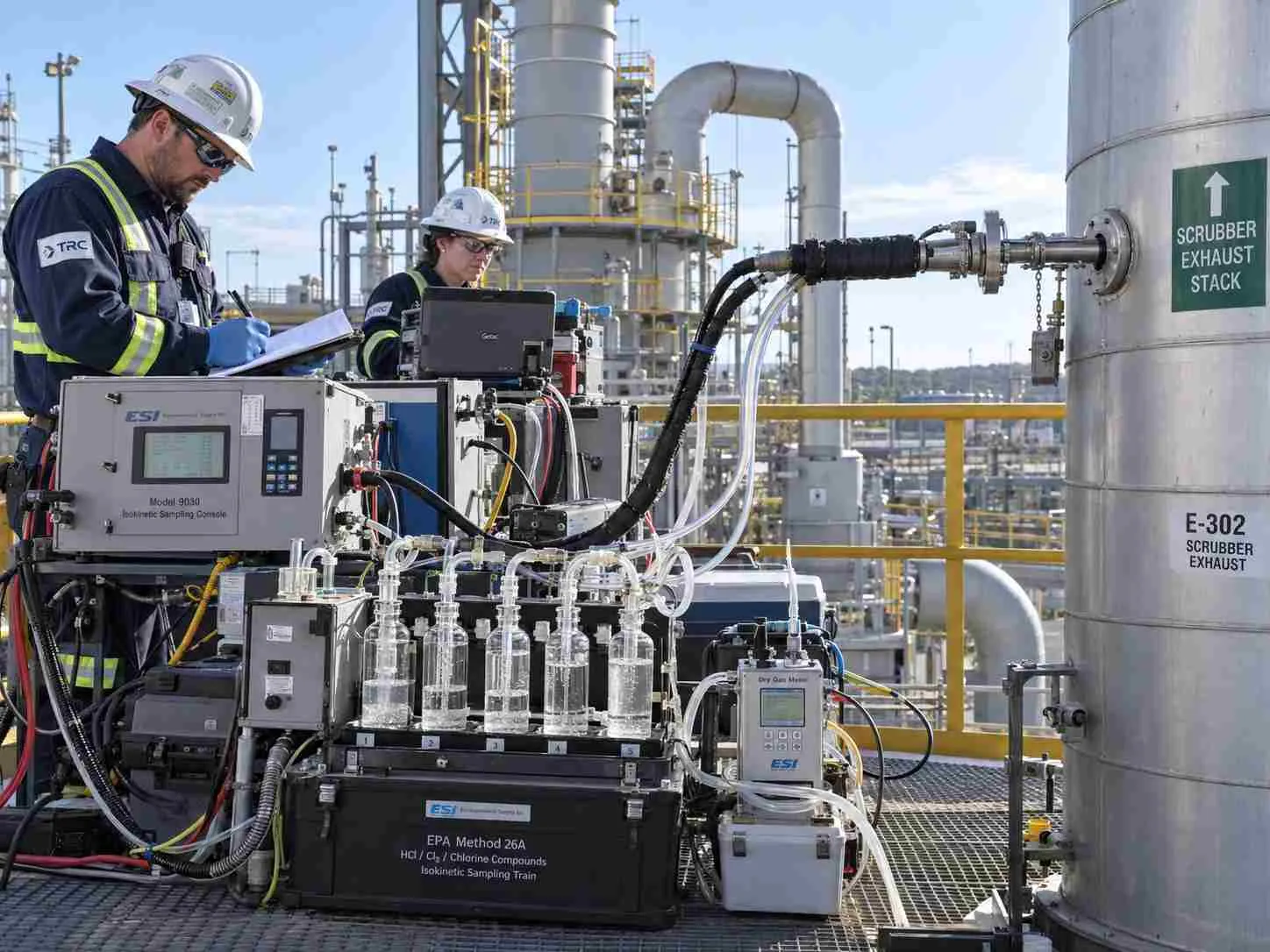
EPA Method 26Aspecifies isokinetic sampling for hydrogen halides and halogens, including sources with acid-containing droplets such as wet-scrubber exhaust. Its analytical procedure uses ion chromatography. It is a test method, not a universal outlet emission limit.
For this representative contract, an independent laboratory would conduct 3 runs of 60 minutes at agreed production conditions. The run schedule is an assumption requiring agreement, not a universal Method 26A rule. Results would be converted to the contract’s dry reference conditions. The testing organization must assess interferences and the applicable method version.
A result above the contractual 10 mg/Nm³ target would require investigation, corrective work and retesting under the agreed acceptance procedure. Permit obligations and legal consequences depend on the actual jurisdiction.
The evidence requirements below supplement Senotay’s quality-control information; no completed certificate or report is implied.
The representative startup problem was intermittent air entering the pH measurement loop. The displayed reading fluctuated, prompting unnecessary dosing corrections. The commissioning team corrected the sample-loop arrangement and verified the reading before tuning the control response. This is an illustrative event, not a documented site occurrence.
Operators would then check the response during an agreed batch-transfer condition rather than tune the system only between batches.
Handover would cover sensor cleaning, calibration, nozzle inspection, pump checks and response to low-flow alarms. Drawings, approved setpoints, operating instructions and a critical-spares list would accompany the training.
The following comparisons relate to 1–7 June 2026 and 1–7 July 2026. They are representative values awaiting records, not measured outcomes.
The illustrative concentration change is calculated as (80 − 8) ÷ 80 × 100 = 90%. A removal-efficiency claim requires paired inlet and outlet pollutant mass flows.
The unexpected benefit in the scenario is easier fault diagnosis: measured circulation and a serviceable sensor help operators distinguish chemical demand from a hydraulic fault. Freshwater consumption does not improve, because the assumed makeup requirement remains unchanged.
Commercial value would come from documented operator time and usable production time. Those benefits must be weighed against reagent, electricity, wastewater and maintenance costs. No installed price or validated annual operating record was supplied, so this draft does not claim a payback period or guaranteed savings.
The liquid-to-gas ratio checks circulation demand, while stoichiometry checks reagent demand. These are different calculations: adding caustic cannot replace liquid contact, and increasing water circulation cannot indefinitely compensate for exhausted reagent.
Liquid circulation, m³/h = gas flow, actual m³/h × liquid-to-gas ratio, L/m³ ÷ 1,000
For the representative duty:
24,000 m³/h × 3 L/m³ ÷ 1,000 = 72 m³/h.
The gas-flow basis is actual operating volume. The ratio is an assumed initial design value, not proof that the selected packing will achieve the target. Verify wetting, flooding margin and pressure loss using the packing supplier’s hydraulic information. The EPA engineering manual explains why absorber diameter, height and pressure loss require separate design checks.
For an illustrative absorbed HCl load of 4.0 kg/h, neutralization requires approximately:
Pure NaOH = 4.0 × 40.00 ÷ 36.46 = 4.39 kg/h.
The ratio uses approximate molar masses of NaOH and HCl in g/mol. For a 20% by-mass NaOH solution:
Solution demand = 4.39 ÷ 0.20 = approximately 21.9 kg/h.
These are theoretical. Other acids, dosing losses and control margin can increase consumption. Pump displacement in L/h also requires the solution density at operating temperature.
Establish maximum actual airflow and temperature, peak pollutant mass loading, full gas chemistry, and the permitted outlet and wastewater conditions. Ask for packing details, pump duty at operating head, nozzle coverage, dosing response and a liquid balance. Require an explanation of how performance changes at peak batch load and how the acceptance test will capture that condition.
Read instrument trends together rather than treating one acceptable value as proof of treatment. EPA’s wet-scrubber monitoring guidanceidentifies liquid flow, pressure differential and liquid condition as important operating indicators.
A normal motor current does not establish correct nozzle flow. Record healthy operating values after acceptance, then use changes to direct inspection. Troubleshooting should preserve source capture and follow the approved isolation procedure before opening the tower or chemical circuit.
Senotay’s product page lists the following range. Capacities, dimensions and efficiencies are catalogue values, not project measurements; packing descriptions are abbreviated.
The representative selection uses Type 7 at 24,000 actual m³/h. Its detailed packing, resin grade, dimensions and utilities require a signed schedule. In the linked product range, this configuration is one of 10 in the range.
Ans: No. The 8 mg/Nm³ outlet is an illustrative case value, not a verified site result. A purchase guarantee must define pollutant, inlet loading, flow, reporting conditions and testing procedure. Replace the scenario figures with signed measurements before publishing the page as an actual deployment report.
Ans:Not automatically. Alkaline liquor suits the selected HCl neutralization duty, while ammonia absorption typically calls for different liquid chemistry. Mixed exhaust requires a composition review and possibly separate treatment stages. Do not combine incompatible streams simply because the equipment family can serve either application separately.
Ans:No. Temperature suitability depends on the complete vessel design, chemical exposure, structural loading and material specification. The representative case assumes 35 °C. Obtain a signed continuous and upset-temperature envelope rather than using a general polymer-property figure as the finished equipment’s allowable operating limit.
Ans:No. Gas absorption depends on the compound and selected liquid, so an acid scrubber is not a universal VOC treatment system. Identify the solvents and their concentrations before quotation. Poorly absorbed compounds may require a separate technology selected for that particular exhaust composition and operating duty.
Ans: Provide actual and reference gas-flow conditions, peak HCl loading, temperature, humidity, other contaminants, layout and the acceptance target. Include available fan margin, water quality and wastewater restrictions. Ask the supplier to separate equipment scope, installation, testing, spares and operating assumptions so quotations can be compared consistently.
For an initial review, send gas composition and existing test results. For a quotation, add layout drawings, utilities and the acceptance target through Senotay’s enquiry page. Request an initial scope response within 2 working days; supplier confirmation is required.
Related reading:
Wet electrostatic precipitation: consider the distinct problem of residual fine acid aerosol.
Horizontal electrostatic precipitation: compare particulate collection with gas absorption.
Senotay application cases: request documented chemical-industry and cross-industry scrubber references before selecting comparable projects.