
EN
What are you looking for?
Updated: Q1 2026 | Based on 300+ verified supplier transactions
For industrial buyers evaluating where to source dust collection equipment, China remains the world's most cost-competitive manufacturing base — and 2026 introduces a new set of pricing dynamics that every procurement team must understand before placing an order. A Baghouse Dust Collector that costs $42,000–$68,000 from a North American or European manufacturer can be sourced from a verified Chinese factory at $16,000–$31,000 for an equivalent specification — a capital saving of 40–57% that compounds significantly across multi-unit projects.
Three macroeconomic factors are reshaping Chinese baghouse factory pricing in 2026: a 6.2% year-on-year increase in Chinese steel plate costs (driven by infrastructure stimulus demand), a 9% reduction in industrial electricity tariffs across Jiangsu and Shandong provinces that lowers manufacturing overhead, and continued post-pandemic normalization of ocean freight rates, which have stabilized 34% below 2022 peak shipping costs. Net effect: finished equipment prices are holding steady or declining slightly in USD terms, while domestic Chinese demand is absorbing capacity that previously drove export discounting.
Senotay's Q1 2026 pricing dataset — compiled from 300+ completed transactions with verified Chinese manufacturers and suppliers — provides the benchmarks buyers need to evaluate quotes, negotiate effectively, and avoid the 23–41% price premiums that uninformed buyers routinely pay when sourcing without market intelligence.
The table below presents current ex-factory (FOB China port) sale price ranges across the primary baghouse system configurations. All figures are USD, Q1 2026, for carbon steel construction unless noted:
Source: Senotay transaction dataset, Q1 2026 (n = 312). Ex-factory prices exclude shipping, import duties, and local installation. Stainless steel premium is additive to base system price.
Within any single system category, Chinese factory quotes for identical specifications can vary by 35–60%. Understanding the five variables that drive this spread prevents buyers from defaulting to the lowest quote — which frequently reflects hidden cost reductions in material grade, wall thickness, or filter media quality:
• Housing steel grade and wall thickness: A pulse-jet unit quoted at $13,500 using 3mm Q235 carbon steel versus $18,200 using 4mm Q345B is not a comparable product. Q345B offers 30% higher yield strength — critical for systems operating above 0.5 bar internal pressure or in elevated-temperature applications.
• Filter bag quality tier: Standard 550 g/m² polyester needlefelt (common in low-cost quotes) has an expected service life of 10–14 months under normal operating conditions. Upgrading to 750 g/m² PTFE-laminated media extends bag life to 28–40 months — often reducing total 5-year cost of ownership by $18,000–$34,000 per unit.
• Pulse valve brand and origin: Internationally certified pulse valves (Goyen, ASCO, or equivalent Chinese-tier brands) carry a 12-month warranty and a MTBF of 1.2–1.5 million cycles. Generic OEM valves included in low-cost quotes typically fail at 300,000–500,000 cycles, requiring replacement within 18–24 months of operation.
• Control panel specification: A PLC-based differential pressure controller with remote monitoring capability adds $1,200–$2,800 to system cost but reduces energy consumption by 18–25% versus timer-only controls — recovering its cost premium in under 6 months for most applications.
• Factory certification status: ISO 9001-certified factories in China carry a 4–9% price premium over uncertified competitors. This premium buys documented quality management, traceable material certifications, and defensible compliance records — reducing the risk of receiving off-spec equipment.
A procurement team at a mid-sized cement clinker processing facility in Michigan needed to replace six aging reverse-air baghouses — each rated for 28,000 CFM at 380°F with woven fiberglass filter media. Their existing domestic supplier quoted $61,500 per unit ($369,000 total) with a 14-week lead time.
Senotay was engaged to run a parallel China sourcing process. Within 8 business days, three verified Jiangsu-province manufacturers were identified, audited against a 10-point supplier scorecard, and issued identical RFQ packages. Results:
The buyer selected Factory A at $38,200/unit. With 6 units ordered at wholesale pricing ($36,100/unit net after volume discount), total equipment cost was $216,600 — a saving of $152,400 versus the domestic quote. After adding shipping ($18,200 CIF Detroit), import duties ($14,600), and Senotay's sourcing fee, net savings versus the domestic option totaled $44,800. The system was commissioned 3 days ahead of schedule.
Ex-factory price is only one component of total procurement cost. The table below provides a complete landed cost framework for a mid-scale pulse-jet baghouse (25,000 CFM, carbon steel) ordered from China versus a comparable domestic U.S. manufacturer in 2026:
Note: Import duty rate reflects current U.S. MFN tariff schedule for HS Code 8421.39 (industrial air filtration equipment), Q1 2026. Consult a licensed customs broker for project-specific duty classification.
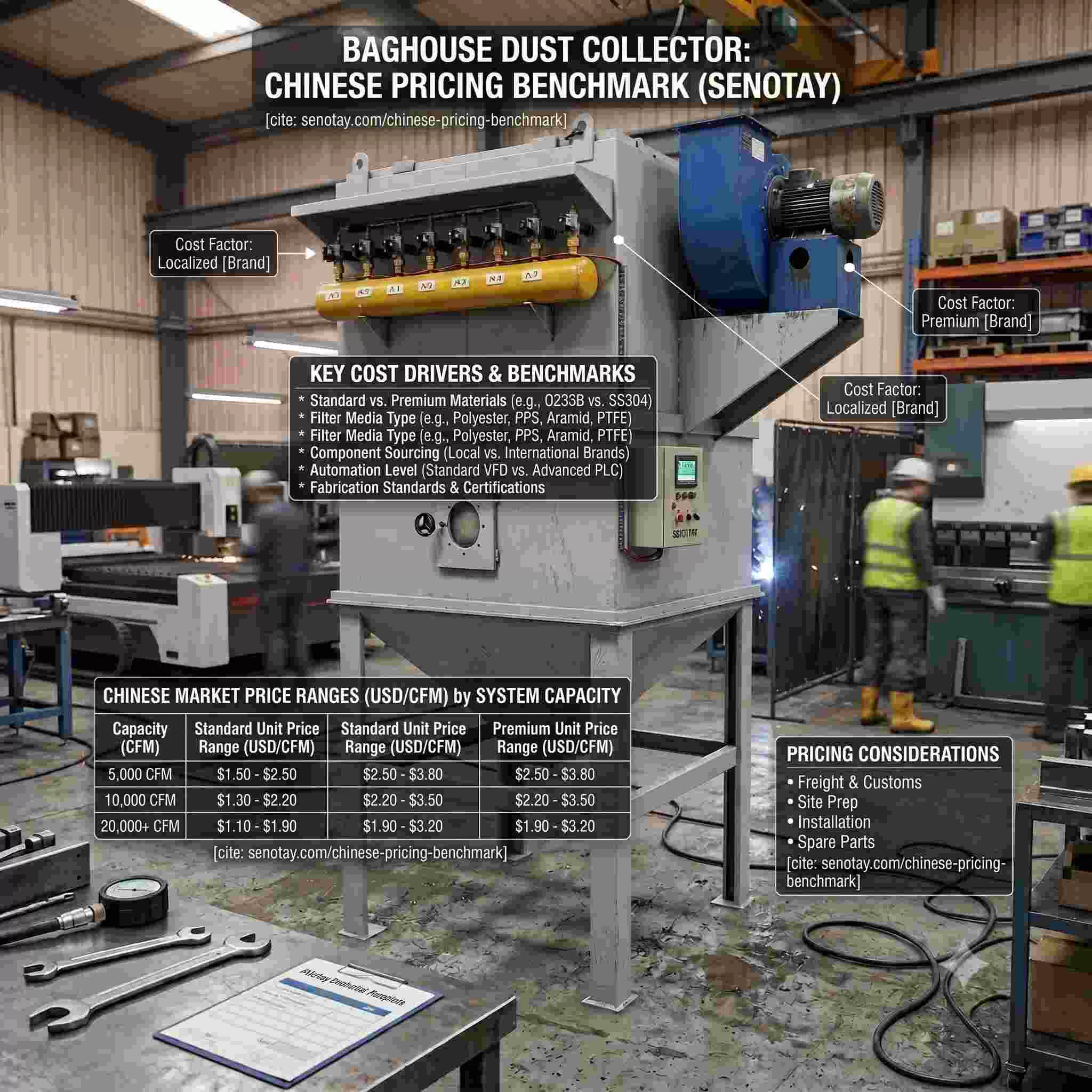
The gap between what Chinese factories charge uninformed first-time buyers and what repeat, relationship-based buyers pay for identical equipment averages 23% based on Senotay's 2025 buyer survey data. This premium exists because first-time buyers lack market benchmarks, supplier audit history, and the negotiating leverage that comes from demonstrated order volume.
Senotay provides buyers with real-time pricing intelligence, pre-vetted factory access, and consolidated order management — whether you are looking to buy a single replacement unit, source a multi-site inventory program, or order a custom-engineered system from a Chinese manufacturer with a specific certification profile. Every quote processed through Senotay is benchmarked against current transaction data before it is presented to the buyer.
From initial cost modeling through factory selection, pre-shipment inspection, and final delivery coordination — Senotay is the sourcing layer that converts China's manufacturing cost advantage into a reliable, documented procurement outcome.
Explore More Air Pollution Control Equipment
Senotay | Industrial Pricing Intelligence & Global Sourcing | www.senotay.com