
EN
What are you looking for?
When engineers and procurement teams evaluate a Baghouse Dust Collector, one engineering parameter consistently separates high-performing systems from costly underperformers: the Air-to-Cloth Ratio (ACR). Also referred to as the filtration velocity or face velocity, the ACR directly governs filter bag life, pressure drop stability, emission compliance, and long-term operating cost — making it the foundational calculation in any system design or audit.
Industry data from the Industrial Ventilation: A Manual of Recommended Practice (ACGIH, 29th Ed.) indicates that incorrectly specified ACR values are responsible for 42% of premature baghouse filter failures globally. A 2022 operational study across 85 U.S. manufacturing facilities found that plants operating outside their optimal ACR range spent an average of $31,000 more per year in energy and maintenance costs than facilities within specification.
Senotay works with industrial buyers worldwide to source properly engineered dust collection systems and filter media — ensuring ACR specifications are validated before any order is placed or equipment is shipped from the factory.
The ACR formula is straightforward, but its inputs require precision:
For example: a baghouse handling 24,000 CFM with 6,000 ft² of filter cloth yields an ACR of 4.0 ft/min — squarely within the recommended range for most dry, non-hygroscopic dusts in manufacturing environments.
• Volumetric Airflow (CFM): Total process exhaust volume, typically measured at operating temperature. A 10°F change in gas temperature can alter actual CFM by 1–2%, affecting ACR accuracy.
• Total Cloth Area (ft²): The sum of all filter bag surface area in the housing. For a 6-inch diameter × 10-foot bag: Area = π × 0.5 ft × 10 ft = 15.71 ft² per bag.
• Compartment Isolation Factor: In multi-compartment systems, one compartment is typically offline during cleaning. Net effective cloth area is therefore (n−1)/n × total area, where n = number of compartments.
• Safety Margin: Engineers typically apply a 10–15% conservative buffer below maximum rated ACR to account for load variability and surge conditions.
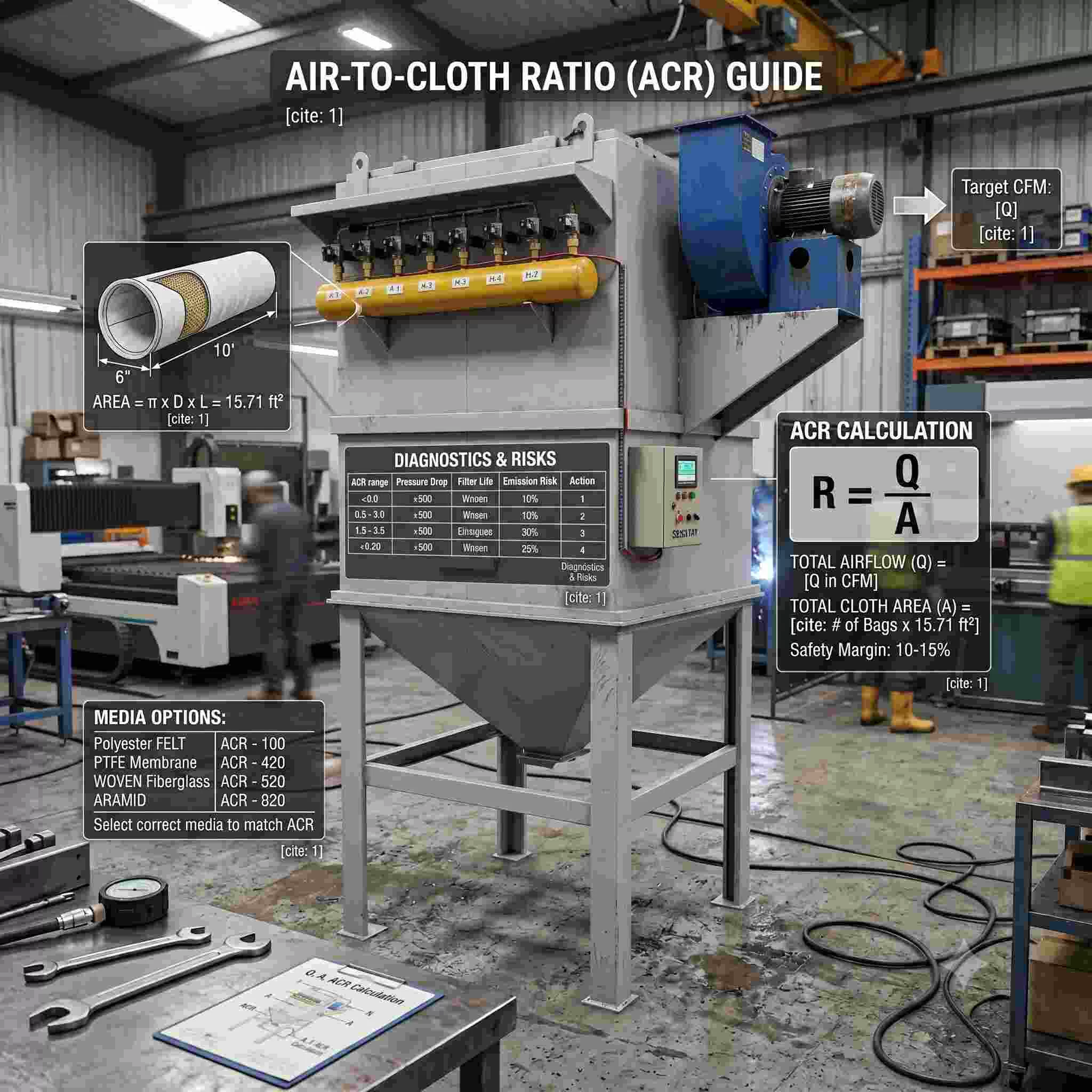
Optimal ACR values vary significantly by application. The table below summarizes industry-standard ranges used by baghouse engineers and validated by Senotay's technical sourcing team:
A wood panel manufacturing plant in Tennessee installed a pulse-jet baghouse rated for 18,000 CFM with 3,200 ft² of polyester filter media — an ACR of 5.6 ft/min. Within 7 months, the facility reported:
• Pressure drop climbing from 3.5 inWG to 9.2 inWG — 163% above baseline
• Filter bag replacement required every 6 months instead of the expected 18 months
• Fan motor energy consumption increased by 24%, adding $8,400 annually to utility costs
• Two regulatory notices for outlet particulate emissions exceeding 0.02 gr/dscf limits
Root cause analysis identified that process duct leakage had increased actual airflow to 22,500 CFM — raising the effective ACR to 7.03 ft/min, well outside the 4.0–6.0 ft/min recommended range for cellulose dust. After duct remediation and a filter media upgrade sourced at wholesale cost from a verified Chinese manufacturer through Senotay, ACR was restored to 4.8 ft/min. Annual operating costs dropped by $47,000 in the following 12-month period.
ACR does not exist in isolation — it interacts directly with filter media porosity, surface treatment, and fiber construction. Choosing the wrong media for a given ACR will accelerate pressure drop buildup regardless of accurate flow calculations. Senotay's supplier network offers a range of engineered filter media optimized for specific ACR bands:
• Standard polyester needlefelt: Best performance at ACR 3.5–6.0 ft/min; cost-effective for general industrial use; available in-stock from Chinese factories with 7–14 day ship lead times
• PTFE membrane laminate: Enables surface filtration at ACR up to 7.0 ft/min with lower pressure drop penalty; 2–3× longer bag life in high-moisture or fine-dust applications
• Woven fiberglass: Specified for high-temperature (up to 500°F) applications at ACR 2.5–4.0 ft/min; critical for cement and coal-fired systems
• Aramid (Nomex) needlefelt: Used in ACR 3.0–5.0 ft/min ranges where continuous operating temperature exceeds 375°F
Senotay sources all media types directly from ISO 9001-certified Chinese manufacturers, with wholesale pricing available for orders exceeding 500 bags. Custom dimensions are manufactured to specification with typical lead times of 10–21 days depending on material and quantity.
Explore More Air Pollution Control Equipment
Getting the ACR right before you buy or order a baghouse system is far less expensive than correcting a miscalculation after installation. Senotay's pre-purchase technical review process includes:
• Process flow audit: Review of actual measured CFM versus design CFM to identify any hidden airflow discrepancies before sizing
• Compartment count optimization: Matching number of filter compartments to application demand, cleaning cycle requirements, and ACR targets
• Media specification matching: Aligning filter bag material, construction, and surface finish to the calculated ACR and dust characteristics
• Supplier quote comparison: Sourcing competitive pricing from vetted Chinese factories with in-stock inventory and certified quality documentation
From initial system design through filter bag replenishment and inventory management, Senotay serves as the technical and procurement bridge between global industrial buyers and the world's most capable filtration manufacturers and suppliers.
Senotay | Industrial Procurement & Filtration Engineering | www.senotay.com