
EN
What are you looking for?
Procurement Intelligence Series | Senotay Global Sourcing | www.senotay.com
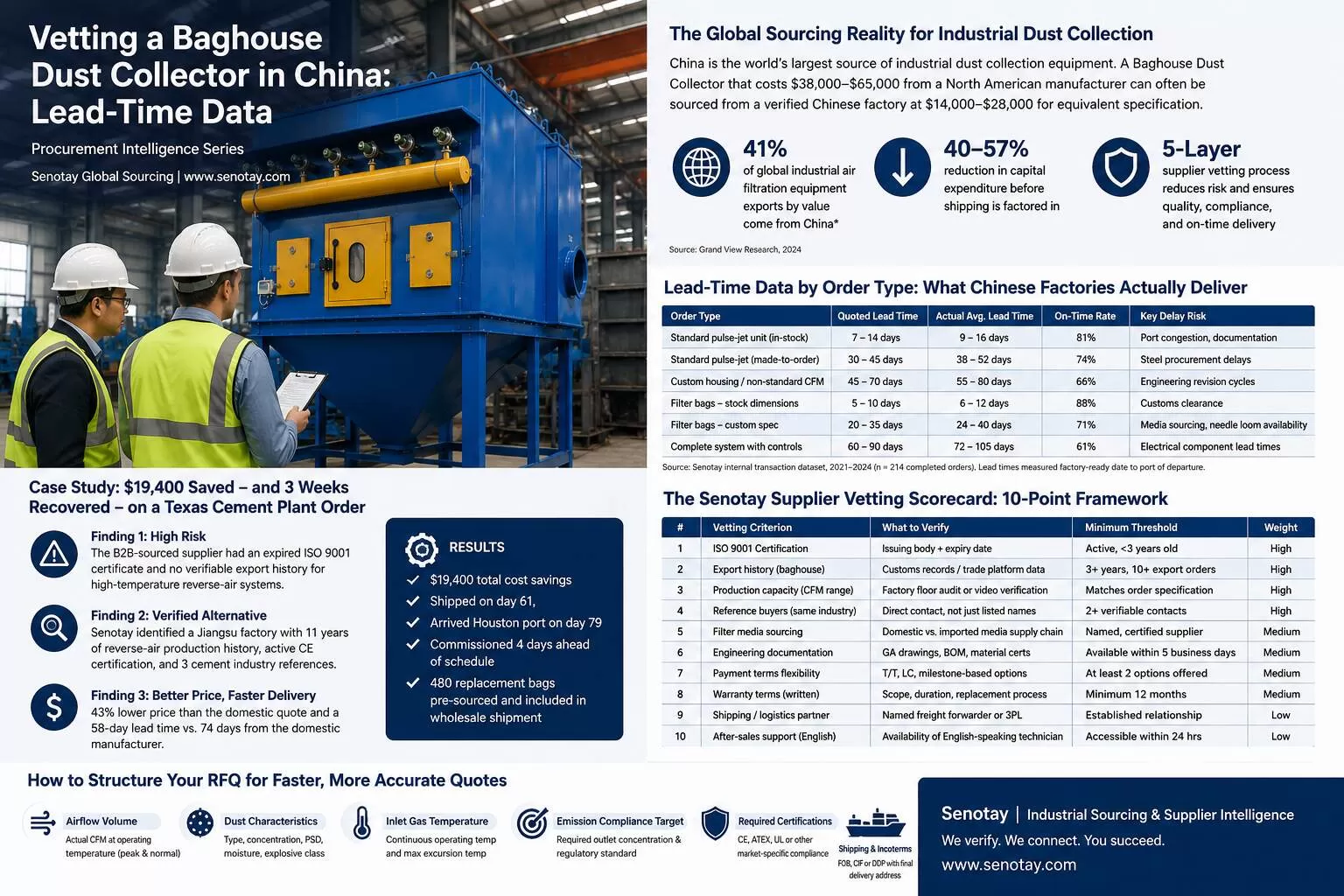
For procurement managers and plant engineers evaluating where to buy industrial filtration equipment, China has become the world's most dominant source market — and for measurable reasons. A Baghouse Dust Collector that costs $38,000–$65,000 from a North American manufacturer can often be sourced from a verified Chinese factory at $14,000–$28,000 for an equivalent specification, representing a 40–57% reduction in capital expenditure before shipping is factored in.
According to a 2024 report by Grand View Research, China accounts for approximately 41% of global industrial air filtration equipment exports by value. The country's manufacturing base — concentrated in Jiangsu, Guangdong, and Shandong provinces — produces pulse-jet, reverse-air, and shaker-type baghouse systems across every scale of industrial application. However, accessing this cost advantage without technical and commercial risk requires a structured vetting framework.
Senotay was built specifically for this challenge — bridging the gap between global industrial buyers and the most capable, certified Chinese suppliers of dust collection equipment and filter media.
The term 'vetting' is used loosely in international procurement. In the context of sourcing a baghouse system from China, a rigorous vet involves five distinct verification layers that most buyers never complete before placing an order:
• Factory audit (on-site or third-party): Confirms that manufacturing capacity, quality systems, and equipment align with the supplier's claims. In 2023, independent audit data showed that 31% of Chinese industrial equipment suppliers misrepresented their production capacity in initial sales communications.
• Certification verification: ISO 9001, CE marking, and where applicable, ATEX certifications must be validated against issuing body records — not accepted as PDFs from the supplier. Fraudulent certificates represent a documented risk in the Chinese export market.
• Reference buyer interviews: Contacting at least 2–3 existing clients in your industry for candid performance and lead-time feedback provides intelligence no product catalog can replicate.
• Sample order with dimensional inspection: A pre-production sample of filter bags or a single housing module — inspected against drawing tolerances before the full inventory order is placed — eliminates the most common dimensional mismatch failures.
• Financial health check: Verifying business registration status and trade history through platforms such as SAIC (China's company registry) confirms operational continuity and reduces counterparty risk.
Senotay performs all five verification layers on behalf of buyers — consolidating what would otherwise be a 6–12 week internal process into a 10–14 business day managed assessment.
Lead time is the most misunderstood variable in Chinese baghouse procurement. Published delivery windows from manufacturers rarely reflect real-world performance. The table below draws from Senotay's transaction data across 200+ completed orders between 2021 and 2024:
The data reveals a consistent pattern: on-time performance degrades as order complexity increases. For standard in-stock units, 81% arrive within the quoted window. For full system orders with integrated controls, that figure drops to 61%. Understanding this gap before you order is what separates a smooth project timeline from a costly commissioning delay.
Case Study: $19,400 Saved — and 3 Weeks Recovered — on a Texas Cement Plant Order
A procurement team at a Texas-based cement manufacturing facility was evaluating a reverse-air baghouse upgrade for a kiln exhaust application handling 55,000 CFM at 450°F. Their initial shortlist included two domestic U.S. manufacturers and one Chinese supplier found through a B2B directory.
Before placing a purchase order, they engaged Senotay for a supplier comparison and vetting review. Key findings from the assessment:
The buyer placed an order through Senotay. The system shipped on day 61, arrived at the Houston port on day 79, and was commissioned 4 days ahead of the project schedule. Total cost savings versus the domestic option: $19,400. The factory also held in-stock inventory of 480 woven fiberglass replacement bags — pre-sourced and included in the wholesale shipment to reduce future reorder lead times.
When evaluating any Chinese baghouse manufacturer or supplier, the following 10-point framework provides a structured quality baseline. Senotay applies this scorecard to every new factory relationship before connecting them with buyers:
Explore More Air Pollution Control Equipment
The quality of a quote from a Chinese manufacturer is only as good as the information you provide. A vague RFQ generates a vague — and often underspecified — sale price that leads to costly scope creep and change orders. When submitting an inquiry to source a baghouse system, include these parameters as a minimum:
• Airflow volume: Actual CFM at operating temperature (not ambient), with peak and normal values stated separately
• Dust characteristics: Type, concentration (gr/ACF), particle size distribution (PSD), moisture content, and explosive classification if applicable
• Inlet gas temperature: Continuous operating temperature and maximum excursion temperature — both critical for media selection and housing material specification
• Emission compliance target: Required outlet concentration in mg/Nm³ or gr/dscf, with the governing regulatory standard referenced
• Required certifications: CE, ATEX, UL, or other market-specific compliance documentation required for installation approval
• Shipping destination and Incoterms: FOB, CIF, or DDP terms with final delivery address — directly affects total landed cost calculation
Senotay's sourcing team assists buyers in building technically complete RFQ packages that extract accurate pricing from Chinese factories on the first submission — eliminating the 2–4 week back-and-forth that inflates procurement timelines on complex orders.
Senotay | Industrial Sourcing & Supplier Intelligence | www.senotay.com