
EN
What are you looking for?
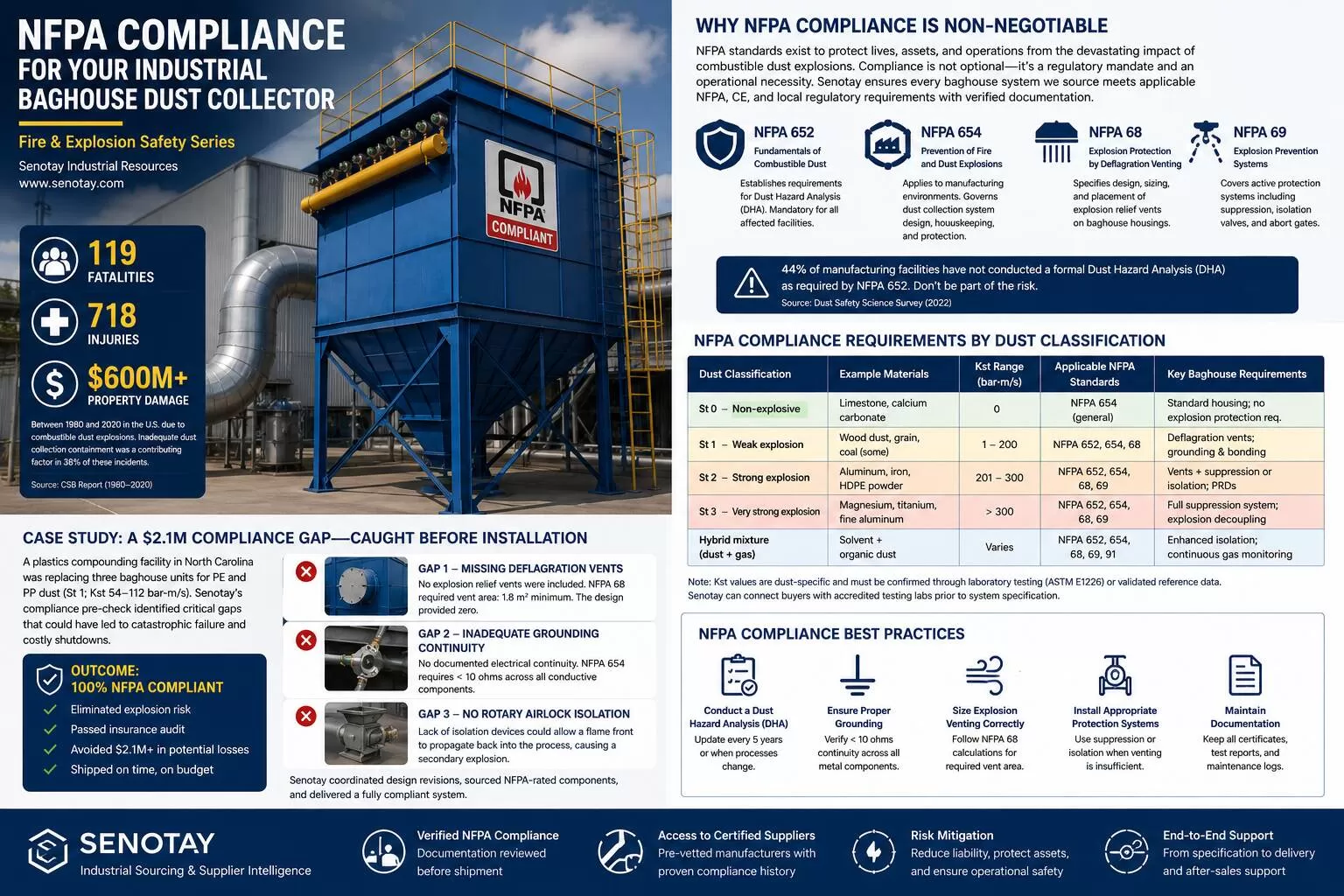
Fire & Explosion Safety Series | Senotay Industrial Resources | www.senotay.com
Every facility that processes combustible dust faces a binary reality: either the Baghouse Dust Collector operating in that environment meets NFPA standards, or it represents an unquantified liability. According to the Chemical Safety and Hazard Investigation Board (CSB), combustible dust explosions caused 119 fatalities, 718 injuries, and more than $600 million in property damage across U.S. industrial facilities between 1980 and 2020 — with inadequate dust collection containment identified as a primary contributing factor in 38% of those incidents.
The National Fire Protection Association (NFPA) has developed a suite of standards specifically governing combustible dust hazards in industrial environments. For plant engineers, safety managers, and procurement teams sourcing dust collection equipment — whether from a domestic manufacturer or a Chinese factory — understanding which NFPA standards apply, and how to verify compliance before you order, is both a regulatory obligation and an operational imperative.
Senotay works with buyers globally to ensure that every baghouse system sourced through its supplier network meets the applicable NFPA, CE, and local regulatory requirements — with compliance documentation verified before any order is confirmed or equipment is shipped.
NFPA has published several standards relevant to dust collection. However, four form the core compliance framework for industrial baghouse installations:
A 2022 survey of 312 U.S. manufacturing facilities by the Dust Safety Science organization found that 44% of respondents had not conducted a formal Dust Hazard Analysis (DHA) as required by NFPA 652 — despite the January 2020 compliance deadline. Facilities operating without a current DHA are exposed to both OSHA citation risk and denial of insurance claims in the event of an incident.
Not all dusts carry the same explosion risk. NFPA compliance requirements escalate with the hazard classification of the material being collected. The table below maps dust type to applicable standards and key design requirements for the baghouse system:
Note: Kst values are dust-specific and must be confirmed through laboratory testing (ASTM E1226) or validated reference data. Senotay can connect buyers with accredited testing labs prior to system specification.
A plastics compounding facility in North Carolina was preparing to replace three aging baghouse units with new pulse-jet collectors handling polyethylene and polypropylene dust — both classified as St 1 combustible materials with Kst values between 54 and 112 bar·m/s.
The procurement team had identified a Chinese manufacturer offering a competitive sale price and 35-day lead time. Before placing the order, Senotay was engaged to conduct a compliance pre-check. The review identified three critical gaps:
• Gap 1 — Missing deflagration vents: The proposed housing design had no explosion relief vents. Under NFPA 68, the required vent area for a 12 m³ vessel with St 1 dust at Pred = 0.1 bar was calculated at 1.8 m² minimum. The unmodified design provided zero.
• Gap 2 — Inadequate grounding continuity: Filter cage-to-housing electrical continuity was not documented. NFPA 654 Section 8.11 requires resistance of < 10 ohms across all conductive components. Non-compliance creates static discharge ignition risk.
• Gap 3 — No rotary airlock isolation: The inlet and outlet transitions lacked deflagration isolation devices. A flame front propagating back through the duct into the process equipment could trigger a secondary explosion in the main production area.
Senotay coordinated factory design revisions, sourced NFPA 68-rated explosion vents from a certified supplier, and specified grounded filter cages with documented continuity testing. The revised system shipped 19 days later than the original quote — but arrived fully compliant, avoiding an estimated $2.1 million in retrofit costs and potential OSHA violations that would have been identified during the facility's next scheduled inspection.
Before specifying, ordering, or installing any baghouse system in a combustible dust environment, NFPA 652 requires a documented Dust Hazard Analysis. The DHA is not a one-time exercise — it must be reviewed every 5 years or whenever a process change occurs that could alter dust generation or collection requirements.
A compliant DHA for a baghouse installation covers seven core elements:
• Dust characterization: Laboratory-tested Kst, Pmax, MIE (minimum ignition energy), and MEC (minimum explosive concentration) values for each collected material
• Hazardous area classification: Zoning of the baghouse housing, clean-air plenum, and surrounding area per NFPA 499 or IEC 60079-10-2
• Ignition source inventory: Identification and control of all potential ignition sources: static, mechanical sparks, hot work, and electrical equipment
• Explosion protection method selection: Passive venting (NFPA 68), suppression (NFPA 69), or containment — documented with engineering justification
• Emergency isolation and abort strategy: Isolation valve sizing and response time calculations per NFPA 69 Chapter 11
• Inspection and maintenance schedule: Filter bag condition, vent integrity, suppression system pressure, and grounding continuity check frequencies
Senotay's pre-order review process incorporates DHA data provided by buyers to ensure that every system specified — and every Chinese factory selected — has the technical capability to manufacture to the required compliance standard before production begins.
Use this checklist when evaluating any baghouse system — whether sourcing from a domestic supplier or ordering from a Chinese manufacturer. Each item maps to a specific NFPA requirement and should be documented in your equipment purchase record:
Explore More Air Pollution Control Equipment
Ordering a baghouse system from a Chinese factory without a compliance verification layer is a risk most facilities cannot afford to absorb. Retrofit costs for non-compliant systems average $45,000–$180,000 depending on vessel size and protection method required — often exceeding the original equipment cost.
Senotay's compliance-integrated sourcing process ensures that no system ships until it meets the buyer's applicable NFPA, OSHA, and local authority requirements. This includes factory-level documentation review, coordination of third-party certification for explosion protection components, and pre-shipment inspection against the compliance checklist above.
Whether you need to source a single replacement unit with standard St 1 protection, or order a multi-compartment system for a high-hazard St 2 application with integrated suppression and isolation — Senotay connects buyers with verified manufacturers that have the engineering depth and in-stock component inventory to deliver compliant systems on time and within budget.
Senotay | Industrial Safety & Procurement Intelligence | www.senotay.com