
EN
What are you looking for?
Choosing the right dust collection system is one of the most operationally significant decisions a plant manager or procurement officer can make. Two technologies dominate the industrial air filtration market: the Baghouse Dust Collector and the Cartridge Dust Collector. Each system carries distinct engineering profiles, total cost structures, and performance envelopes. At Senotay, we have sourced, supplied, and shipped both system types to clients across North America, Europe, and Southeast Asia, giving us a manufacturer-level vantage point for this comparison.
According to Grand View Research (2024), the global industrial dust collector market is projected to reach $12.8 billion by 2030, expanding at a CAGR of 5.3%. Of this, baghouse systems account for approximately 48% of total market revenue, while cartridge units represent around 31%. The remaining share is split among cyclone separators and wet scrubbers. These numbers alone signal why getting your selection right — before you order — directly impacts both compliance costs and operational efficiency.
Baghouse Dust Collector — Built for Volume
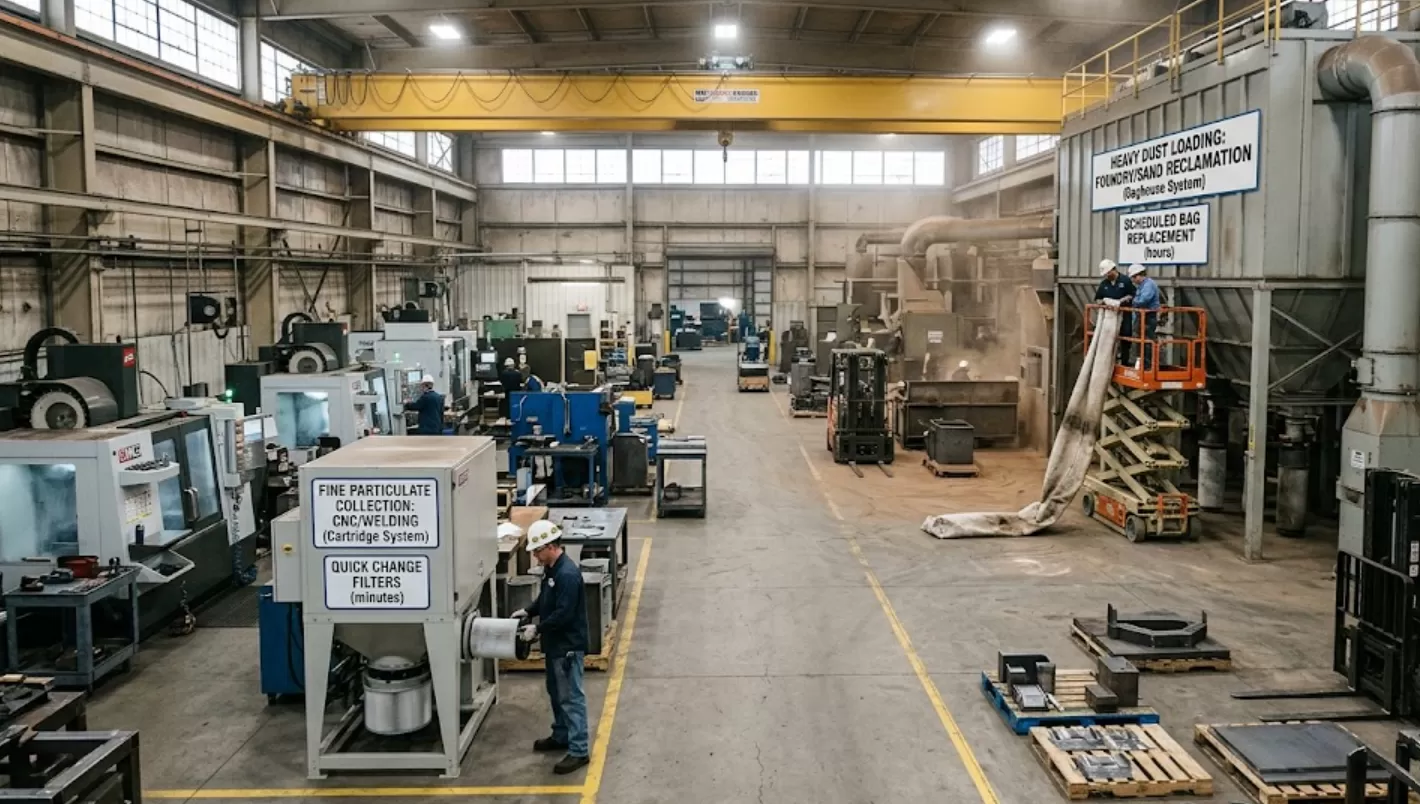
A baghouse operates by drawing particulate-laden air through cylindrical or envelope-shaped fabric filter bags. Dust accumulates on the outer bag surface and is periodically dislodged via pulse-jet, shaker, or reverse-air cleaning. A standard pulse-jet baghouse can process airflow volumes ranging from 5,000 CFM in mid-scale manufacturing to over 1,000,000 CFM in cement plants or power generation facilities. Operating temperatures can reach up to 500°F (260°C) when high-temperature woven bags are specified — a critical advantage in thermal processing environments.
Senotay's factory-direct baghouse inventory includes modular designs that can be configured and shipped within 3–5 weeks, with wholesale pricing available for volume buyers sourcing 3 or more units.
Cartridge Dust Collector — Built for Precision
A cartridge dust collector uses pleated filter media — typically cellulose, polyester, or spunbond polyester — wound into cylindrical cartridges. The pleated design dramatically increases surface area per unit volume, enabling a higher air-to-cloth ratio (6–12 ft³/min per ft²) compared to baghouses (3–6 ft³/min per ft²). This engineering advantage translates directly into a smaller footprint, making cartridge collectors the preferred solution for facilities with space constraints or cleaner dust profiles such as welding fume, pharmaceutical powders, or fine metal particulate.
From a cost standpoint, cartridge systems offer a lower initial sale price — with in-stock units from Senotay available from $3,000 for smaller configurations. However, cartridge replacement costs and downtime must be factored into the total cost of ownership (TCO) calculation.
Source: Senotay engineering data; EPA AP-42 emission factor documentation; ASHRAE filtration standards 2023.
When procurement teams request a quote for dust collection equipment, the unit price is only the starting figure. A rigorous TCO analysis across 5 years of operation reveals a more nuanced picture. The following estimates are based on a mid-scale manufacturing facility processing 50,000 CFM of dusty air:
• Baghouse system (pulse-jet): Initial cost ~$85,000 | Annual maintenance ~$4,200 | 5-year TCO: ~$106,000
• Cartridge system (equivalent CFM): Initial cost ~$42,000 | Annual maintenance ~$7,800 | 5-year TCO: ~$81,000
• Cartridge replacement frequency averages every 18–24 months, versus baghouse bags lasting 2–5 years depending on dust loading
• Energy consumption: Baghouses typically draw 15–25% more power due to higher static pressure requirements
• Senotay clients who switched from third-party suppliers to our direct China factory sourcing channel reported a 22–34% reduction in per-unit cost on repeat orders
A 2023 case study from a mid-sized steel fabrication plant in Ohio documented a 19% reduction in annual filter replacement costs after transitioning from a competitor's cartridge system to a Senotay baghouse configured with anti-static felted bags. The plant processed 28,000 CFM of welding and grinding dust, a profile where baghouse media durability outperformed cartridge filtration over the measured 24-month period.
Note: Senotay provides application-specific consultation at no cost — contact our technical sales team for a custom quote before placing your order.
• Dust particle size and concentration: Submicron particles (< 1 µm) favor cartridge systems with HEPA-grade media; coarse, high-loading industrial dust favors baghouse fabric
• Temperature of the airstream: Processes exceeding 275°F (135°C) require a baghouse — cartridge media degrades rapidly above this threshold
• Available floor space: Cartridge collectors can reduce footprint by up to 60% versus equivalent-capacity baghouses, critical for retrofit installations
• Regulatory compliance: EPA NESHAP and OSHA PEL standards may mandate sub-0.01 grain/ft³ outlet emissions, which both systems can achieve when properly specified
• Supply chain and shipping lead time: Senotay maintains in-stock inventory of standard configurations in both categories, with expedited shipping options for urgent project timelines
Explore More Air Pollution Control Equipment
Senotay operates as a direct-to-buyer Chinese manufacturer and supplier with an integrated quality management system certified to ISO 9001:2015. Our production facility ships baghouse and cartridge systems globally, with documented lead times of 2–6 weeks for standard configurations and competitive wholesale pricing for distributors and OEM buyers.
In 2023, Senotay fulfilled over 340 dust collector orders across 27 countries, with an on-time shipping rate of 96.4%. Our factory maintains a standing inventory of filter bags (woven polyester, PTFE-laminated, and aramid/meta-aramid variants) and cartridge media (cellulose-polyester blend, nano-fiber coated, and MERV-15 rated) to support rapid order fulfillment and reduce buyer-side inventory carrying costs.
Whether your procurement team is sourcing a single replacement unit or placing a bulk order for a multi-site rollout, Senotay offers transparent factory pricing, detailed technical datasheets, and engineering support from specification through commissioning.
Global dust collector market value (2024 estimate): $8.2 billion | Projected 2030 value: $12.8 billion | Baghouse market share: ~48% | Cartridge market share: ~31% | Average filter efficiency (both types, properly specified): 99.9% | Senotay average cost savings vs. spot-market sourcing: 22–34% | Standard Senotay shipping lead time: 2–6 weeks | Countries served (2023): 27 | Orders fulfilled (2023): 340+