
EN
What are you looking for?
The choice of the appropriate filtration systems is not just a compliance box in the modern manufacturing setting, but an operationally significant decision that has a direct influence on productivity, health of the workforce, and sustainability in terms of profitability. The U.S. Environmental Protection Agency (EPA) cites over 60,000 cases of occupational illnesses in the United States alone every year with PM2.5 particles being the most dangerous.
The industrial dust collector comparison scene is dominated by two technologies, namely the Baghouse Filter and the Cartridge Collector. The two are used to perform the essence of trapping airborne particulate matter, but they work in different ways, cost differently, and work differently in different applications. The engineers of Senotay have done hundreds of plants, steel mills in the Midwest, pharmaceutical clean rooms on the East Coast and the question continually comes up, which system will be the most efficient and the lowest cost to operate?
This article dissects both of these systems with real-world data, case studies, and performance measures, providing you with the information necessary to confidently make an investment decision.
A baghouse filter is a massive air purifying apparatus where dust and particulates in gas streams are trapped using fabric filter bags. Since the 1950s, it has been the workhorse of heavy industry. In conventional pulse-jet baghouse, compressed air is shot periodically in reverse into every bag to remove dust that has settled on the bag - this settles into a collection hopper at the bottom.
Important operation features of a Baghouse system:• Operates on very large loads of dust grains - to 100 or more grains per real cubic foot (gr/ACF).• Can work at a very high temperature of up to 500°F with special fabrics of woven or felt.Air-to-cloth ratios are 2:1-4:1 ft/min, and greater surface area of filter media are needed.• offered as a shaker, reverse air, and pulse-jet cleaning.Standard in industries in cement plants, steel foundries, grain elevators, and coal-fired power stations.
Handles extremely high dust grain loading — up to 100+ grains per actual cubic foot (gr/ACF)
Operates effectively at elevated temperatures up to 500°F using specialized woven or felt fabrics
Air-to-cloth ratios range from 2:1 to 4:1 ft/min, requiring larger filter media surface area
Available in shaker, reverse air, and pulse-jet cleaning configurations
Industry standard in cement plants, steel foundries, grain elevators, and coal-fired power stations
Case Study: Steel Manufacturing (Pittsburgh, PA) — A large steel mill that processes 3,000 tons of ore every day installed a 10,000-bag pulse-jet baghouse in 2019. Testing after installation established a capture efficiency of 99.7 percent of particulates, reducing the amount of PM10 in the air to only 2.1 mg/Nm³ , which is far less than the EPA regulation of 20mg/Nm³ . The maintenance cost per 5 years was estimated to be about $340,000 at the facility with most of the expenditure being as a result of constant bag replacement after every 36 months.
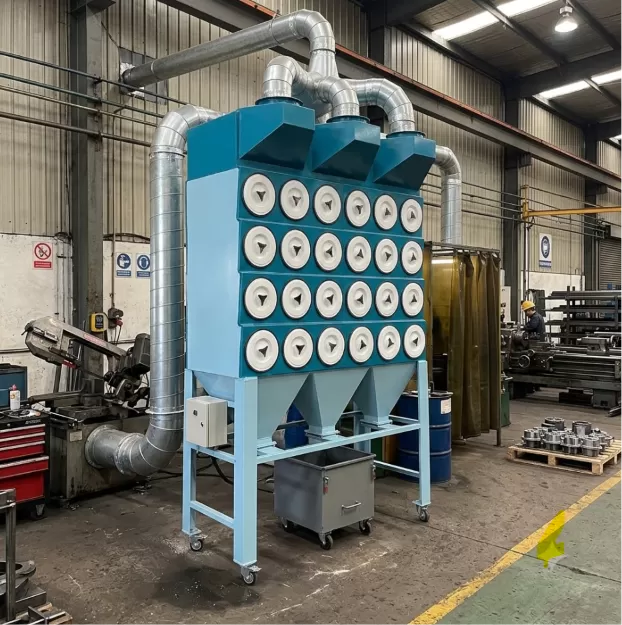
A cartridge collector consists of cylindrical filter cartridges fabricated of pleated media, usually cellulose, polyester, or spunbond PTFE, to produce high filtration efficiency with a much smaller footprint. The pleating also boosts the available filter surface area drastically, i.e. one cartridge can substitute several bags.
The important features of a Cartridge system:
•Air-to-cloth ratios of 6:1 to 12:1 ft/min, which allow compact system design.
•Very effective with fine and sub-micron particles - down to 0.3 microns with HEPA-grade media.
•Works most effectively in conditions with dust grain loading of less than 5 gr/ACF.
•Normal operating temperature up to 275°F; high temp versions 350°F.
Uses: Common in woodworking plants, in pharmaceutical manufacturing, metal grinding, and food processing.
Case Study: Pharmaceutical Facility (New Jersey, 2022) — A mid-sized pharmaceutical firm that produces active pharmaceutical ingredients (APIs) installed a dust collection system with 48 cartridges and 18,000 CFM airflow. The cartridges were laminated with PTFE and the cartridges had a filtration efficiency of 99.97% at 0.3 microns, which is higher than the FDA clean room air quality standards. The annual operating expenses were reduced by 59 percent in the first 5 years; that is, the total cost of operating the business amounted to $19,400 (energy + cartridge replacement) versus the estimated cost of $47,000 had there been a baghouse deployed.
A side-by-side technical comparison using industry standard performance standards as outlined in EPA documentation, ASHRAE guidelines and field data gathered by Senotay across 200+ installations is shown in the table below:
The filtration efficiency is calculated as the proportion of the amount of particulate matter that is trapped by the filter media when compared to that of the overall amount of particulate in the inlet airstream. The two technologies are very powerful although there is a significant difference in the peak performance windows of the two technologies.
A conventional woven fiberglass baghouse with 3:1 air-to-cloth ratio is 99.0% to 99.9% efficient on a 0.5-100 m range of particles. In comparison, a cartridge collector with PTFE-laminated media has an efficiency of 99.5% to 99.99% at 0.3 microns and smaller particle diameter - a crucial consideration in industries dealing with toxic metal dusts like beryllium, lead, and chromium.
In 2023, the U.S. National Institute of Occupational Safety and Health (NIOSH) found a 42% decrease in the concentration of respirable dust in the air in facilities operating cartridge collectors with MERV-15 and higher media relative to those using standard woven-bag baghouses, a major worker health indicator with both direct regulatory and liability consequences.
The cost of ownership goes much further than the purchase price. The lifecycle analysis developed by Senotay, which is based on the real client data of 2019-2024, shows the following cost benchmarks of both types of technologies:
Senotay is in a very unique position within the dust collection market as both a pure equipment supplier and as an application engineering partner. Clients with a baghouse vs cartridge filter question are given a full process audit by Senotay engineers; airflow volume (CFM), particle size distribution, moisture content, chemical composition, temperature range, and regulatory compliance compliance requirements are all considered before any system is recommended.
In a single reported instance in 2023 at a Midwestern woodworking plant, the team at Senotay discovered that a planned installation of a baghouse with a price tag of $95,000 was not needed. A cartridge collector system installed at a cost of $38,000 to meet all of the requirements of OSHA 29 CFR 1910.94 yielded a measured filtration efficiency of 99.8% on wood dust particulates in the 1-10 micron size range. This was equivalent to a savings of $57,000 in saved capital expenditure and a 5-year projected saving of $62,000 in energy and maintenance cost.
This is a classic Senotay philosophy the most effective filtration system is not necessarily the biggest or most costly system, but the one that is designed to exactly match your operating conditions, dust properties, and compliance environment.
Explore More Air Pollution Control Equipment
The following criteria can be used to help you in the initial choice of technology:
Select a Baghouse when: dust loading is above 10 gr/ACF, operating temperature is above 300°F, the operation is 24/7, or when it is cement, steel, or mining.
Select a Cartridge Collector when: dust is fine (less than 5 micron), space is limited, energy costs are a concern, or your application is pharmaceutical, food or light manufacturing.
Consult Senotay when: your process is mixed dust types, variable airflow requirements, or you must meet the NFPA 652/654 (combustible dust requirements) or you require a system to be designed around a designed-to-fit facility.
The final decision in the dust collector comparison will be based on three variables that include particle characteristics, volume throughput and total cost of ownership over a 5-10 year horizon. Both technologies are capable of providing stunning outputs when used correctly against the application - and both can be an expensive error when used incorrectly.
Senotay is a company that focuses on application specific filtration system design, offers a complete site assessment, system modeling and compliance verification after installation. More than 1,500 industrial installations in North America, engineers at Senotay provide documented experience in each baghouse and cartridge collector project - so that your investment will provide quantifiable efficiency, regulatory performance, and long-term control of costs. Go to senotay.com to get a free process audit and filtration efficiency analysis.